92
yerba mate tea
based on 773 reviews
Your savings will grow with each shipment. Save 5% now, and up to 15% in the future. Please select size:
sample
makes 10 cups
$3
3oz
24¢ per cup
$9
16oz
15¢ per cup
$29
teabags
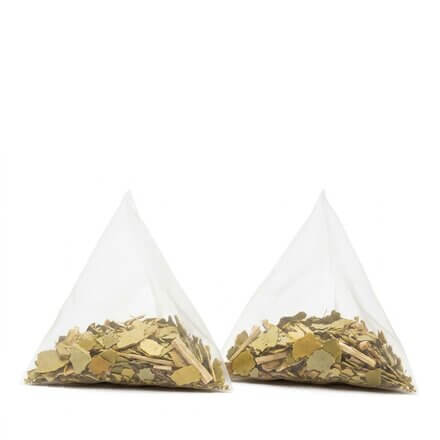
15 full leaf pyramids
$9
Long hailed in South American countries as a healthy, energising social beverage, Yerba Mate is finding a new audience in North America. Made from the leaves and stems of Ilex paraguariensis — a species of South American holly, not the tea plant — it delivers energy without the jitteriness many experience with coffee. Our yerba mate is Argentine, hot air-dried and never smoked. The "never smoked" distinction matters: smoked yerba mate has a sharper, more acrid character; air-dried produces the cleaner, more herbaceous cup that most Western buyers prefer. Its taste has been compared to green tea but with a more herbaceous, grassy character — earthy, lively, tangy, with faint hints of tobacco and grass. Enjoyed hot or iced, it can also be mixed with fruit juices for an energising punch.

TEA TYPE
Herbal Tea

CAFFEINE
High
A fuller caffeine level, ideal for morning or early afternoon, and typically still lower than coffee.

STEEP
150° for 3-5 mins
Steep longer for a fuller infusion and more pronounced botanical flavor.
Customer Reviews (773)
Teabags
teabags
15 full leaf pyramids
$9
Lore
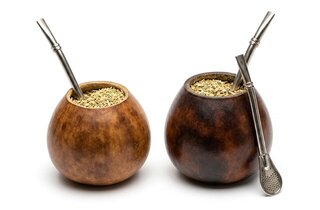
Most teas are prepared using four simple steps: add the tea leaves to water, steep the tea leaves, remove the tea leaves, enjoy. Mate (pronounced Mah-tay) is not most tea. Besides being made from the South American yerba mate plant (a type of holly) instead of the tea plant, it is also enjoyed with the leaves still in the cup. To prepare it, Mate afficionados first pack their cup with yerba mate twigs and leaves. They then add water before poking a filtered metal straw right into the leaves. The tea is then shared socially, passing from person to person.
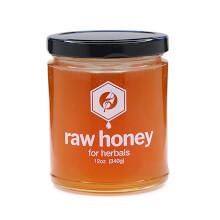
Raw Honey for Herbals
12oz
honey for garden herbals
$9
Questions and Answers
Ask a question about yerba mate and have the Adagio Teas community offer feedback.
Compared to matcha, how much caffeine is in this?
Asked by Katrina Quoka
on October 18th, 2020
on October 18th, 2020
how are your yerba mates processed? Are they streamed or smoked?
Asked by Regina McCluster
on July 13th, 2020
on July 13th, 2020
how should you brew this to get the most out of the caffeine (amount, time, temperature, etc) ?
Asked by Rissa
on October 9th, 2020
on October 9th, 2020
is the yerba mate un-smoked
Asked by Joe Cawley
on December 20th, 2022
on December 20th, 2022
Hello, the previously answers on 's weren't really clear. The 'smoked' refers to the drying process at harvest- how is the plant dried/processed when harvested? Some plantations smoke the plant to dry it. Smoking is suspected to produce carcinoge
Asked by Debbie Crookston
on August 21st, 2023
on August 21st, 2023
Direct Trade Advantage
We import directly from the artisan farmers whose names and faces you'll find throughout our website.
This makes our products fresher than those offered by the companies who use middlemen and brokers, and also less expensive.
Here's a comparison of how much more you'd be paying by buying this elsewhere:
David's Tea:
72% more expensive
What Is Yerba Mate Tea?
Yerba Mate Tea (yerba maté, mate) is an infusion made from the dried leaves and stems of Ilex paraguariensis — a species of South American holly native to the subtropical regions of South America, particularly Argentina, Paraguay, Uruguay, and southern Brazil. It is emphatically not related to the tea plant (Camellia sinensis); the "tea" in "yerba mate tea" is used in the Western sense of "a hot infusion," not in the botanical sense of the tea plant.
With deep roots in South American Indigenous culture — first used by the Guaraní people before becoming a defining social tradition across the Southern Cone — yerba mate is one of the world's most widely consumed caffeinated beverages. In Argentina, Uruguay, and Paraguay, it is the dominant hot drink, consumed in greater volume than coffee or conventional tea. Adagio's version is Argentine — sourced from the world's largest yerba mate-producing country — and hot air-dried rather than smoked.
Hot Air-Dried vs. Smoked Yerba Mate: The Quality Distinction
Not all yerba mate is processed the same way, and the processing method significantly affects the character of the cup. The two primary methods:
- Smoke-dried (most traditional Paraguayan and Brazilian styles) — the harvested leaves and stems are dried over wood fires, which imparts a distinctive smoky, slightly acrid character to the finished product. Smoke-dried mate is the original traditional style and remains preferred in parts of Paraguay and Brazil, but the smoke character can be polarising for Western buyers unfamiliar with the taste.
- Hot air-dried (Argentine style, including Adagio's) — the leaves and stems are dried using hot air rather than smoke, producing a cleaner, more purely herbaceous character without any smoked dimension. The "never smoked" claim in the product description is the key quality signal: Adagio's yerba mate delivers the earthy, herbaceous, lively character of quality yerba mate without the smoke that many first-time buyers find unexpected or off-putting.
For any buyer new to yerba mate — particularly buyers approaching it as a coffee alternative or as an herbal tea experience — hot air-dried Argentine yerba mate is the recommended starting point. The cleaner character is more approachable and more representative of how yerba mate tastes at its finest.
The Mate Ritual: How Yerba Mate Is Traditionally Prepared
The Lore section describes the traditional preparation of mate, and it is worth understanding because it is genuinely unlike any other beverage preparation:
Traditional mate preparation uses three specific items not required for any other tea in the Adagio catalog:
- The gourd (mate or guampa) — a small cup made from a hollowed gourd, wood, or calabash. The gourd is the vessel in which the mate is prepared and drunk. No separate steeping vessel; the gourd is both the brewing vessel and the cup.
- The bombilla — a filtered metal straw, typically silver or stainless steel, with a filtered end that sits in the mate leaves. The drinker sips through the bombilla, which strains the leaves from the liquid. No separate straining required; the bombilla is the filter.
- The leaves remain in the cup — unlike virtually every other tea style, mate is drunk with the leaves still present in the gourd throughout the session. Water is added repeatedly to the same leaves; the bombilla is never removed.
The social dimension: the Lore section notes that the tea "is shared socially, passing from person to person." In South American mate culture, a prepared gourd is passed among a group — each person sips through the same bombilla and passes the gourd to the next person for a refill of water. The host refills the gourd with fresh hot water between each person. This is the original "passing around" of mate, and it is the central social ritual through which mate is consumed across South America.
For Western loose leaf brewing: steep in an infuser or teapot at 150°F for 3–5 minutes, strain, and serve. The traditional gourd-and-bombilla approach is authentic; loose leaf infuser brewing is practical and delivers the same flavour from the same leaves.
Yerba Mate as a Coffee Alternative
The most commercially significant use case for Adagio's Yerba Mate in the Western market is as a coffee alternative — and the product description addresses this directly: "Notable is its ability to provide energy without the jitteriness suffered by coffee imbibers."
The pharmacological distinction between mate and coffee energy is real and worth understanding:
- Caffeine content — yerba mate contains caffeine (approximately 30–80mg per 8oz cup depending on preparation), comparable to a moderate cup of coffee. Adagio's caffeine panel rates it as High for an herbal tea.
- Theobromine and theophylline — yerba mate also contains theobromine (the compound in chocolate responsible for its gentler, longer-lasting stimulant effect) and theophylline (also found in tea). These compounds work alongside caffeine to produce a more sustained, less abrupt stimulant effect than caffeine alone.
- Why "without the jitteriness" — the combination of caffeine with theobromine and theophylline, alongside mate's antioxidant and chlorogenic acid content, appears to produce a stimulant profile that many drinkers describe as more focused and less anxious than equivalent caffeine from coffee alone. This is individual and anecdotal but consistent enough across users that it is the defining commercial claim for mate in Western markets.
Yerba Mate Flavour Profile
- Earthy and woody — the foundation of the cup. The dried leaves and stems of the holly plant produce a warm, earthy, slightly woody character that is immediately unlike green tea despite the review comparison. Think forest floor, bark, dried herbs — the herbaceous quality of a plant that grows wild in subtropical South America.
- Lively and tangy — the product description's characterisation. A slight tartness or brightness that prevents the earthiness from being heavy — a lively quality that makes each sip feel fresh despite the depth of the flavour.
- Faint tobacco and grass — the specific notes the meta description names. Not cigarette tobacco but the warm, slightly dry quality of cured leaf material alongside a clean grassy green dimension from the holly plant.
- Evolving character across steepings — reviewers consistently note that yerba mate changes across multiple steeps. The first steep is the most intense and most bitter; subsequent steeps are lighter and more purely herbal. The evolution is part of the traditional mate experience — the gourd is refilled repeatedly with the same leaves throughout a session.
- Delicately minty or citrusy dimensions — reviewers occasionally identify subtle mint or citrus qualities in the background. These are most present in the lighter second and third steepings and are characteristic of high-quality air-dried Argentine mate.
Yerba Mate vs. Coffee: A Practical Comparison
| Yerba Mate | Drip Coffee | |
|---|---|---|
| Caffeine per 8oz | ~30–80mg | ~95–165mg |
| Theobromine | Present | Trace only |
| Tannins | Moderate | Moderate |
| Preparation complexity | Low (loose leaf infuser) | Low–moderate |
| Cost per cup (Adagio) | 15¢ (16oz pouch) | 20–50¢+ |
| Caffeine profile | Sustained, less abrupt | Quicker onset |
The practical comparison: yerba mate delivers meaningful caffeine at a lower price per cup than coffee, with a sustained energy profile that many buyers find more comfortable for extended focus. It does not taste like coffee — it tastes like what it is, which is an earthy South American herbal — but the functional profile is the closest of any beverage in the Adagio catalog to a genuine coffee replacement.
How to Brew Yerba Mate Tea
- Water temperature — 150°F (65°C). The lowest brewing temperature in the Adagio herbal catalog, and significantly lower than the 212°F used for chamomile, peppermint, spearmint, and lemongrass. This is specific and important: mate brewed at boiling temperature produces a harsh, overly bitter cup. The low temperature is the primary quality variable for Western loose leaf mate brewing — a variable temperature kettle is worth having for this tea specifically.
- Leaf quantity — one to two heaping teaspoons (3–5g) per 8oz cup. Mate is typically brewed at a higher leaf-to-water ratio than most herbal teas, reflecting the traditional gourd method where the gourd is packed generously.
- Steep time — 3–5 minutes. Three minutes produces a lighter, more delicate cup; five minutes produces the fuller, more intense herbaceous character. Do not steep at boiling temperature regardless of time.
- Multiple steepings — yerba mate is highly suited to multiple steepings. First steep: the most intense, most tangy, most tobacco-adjacent character. Second steep: lighter, more purely herbal, the citrusy and minty dimensions more present. Third and fourth: progressively lighter, still flavourful. The traditional mate session involves many refills of hot water over an extended period.
- With sweetener — a small amount of sugar, honey, or agave softens the tangy edge and brings the herbal sweetness forward. Reviewers consistently note that sweetener improves the cup for those new to mate.
- With fruit juice — the product description mentions mixing with fruit juice "for an energising punch." Orange juice and lemon juice are the most natural pairings; the citrus amplifies mate's own lively tartness.
Yerba Mate Tea Caffeine Content
Yerba Mate contains approximately 30–80mg of caffeine per 8oz cup — rated High in the Adagio herbal caffeine panel and clearly flagged with a red warning on the product page: "This herbal tea contains a moderate amount of caffeine." At the 150°F recommended brewing temperature and 3–5 minute steep time, a standard 8oz cup typically delivers 30–50mg; at longer steeping times or higher temperatures, caffeine extraction increases significantly.
This is the only herbal tea in the Adagio catalog with a High caffeine rating and the only one with an explicit caffeine warning on the page. Buyers managing caffeine intake should note: yerba mate is not a caffeine-free herbal tea. It is a caffeinated beverage that happens to be brewed as an infusion rather than as coffee or tea.
Yerba Mate Tea as a Gift
Yerba Mate is the most culturally distinctive herbal tea gift in the Adagio collection — the one that introduces the recipient to a completely different beverage tradition rather than a different style within the familiar tea world. The combination of the South American holly plant, the gourd-and-bombilla social ritual, the specific Argentine air-dried quality, and the "energy without jitteriness" coffee-alternative positioning makes it a gift with genuine story depth.
Available in a sample ($3, 10 cups), 3oz ($9, 37 cups, 24¢/cup), 16oz ($29, 193 cups, 15¢/cup), and pyramid teabags ($9, 15 bags). The 3oz pouch at $9 is the ideal gift size. For the most authentic experience, pair with a traditional mate gourd and bombilla set — the vessel is inseparable from the ritual, and gifting the tea alongside the proper vessel transforms a product into a cultural experience.
Buy Yerba Mate Tea Online
Order Yerba Mate loose leaf herbal tea online — Argentine hot air-dried yerba mate (Ilex paraguariensis), never smoked, scored 92 by 773 customers, from 15¢ per cup. Contains caffeine. Free shipping on qualifying orders. Available in sample, 3oz, and 16oz loose leaf pouches and pyramid teabag format. Delivered from Adagio's New Jersey warehouse within one business day.