93
rooibos tea
based on 1318 reviews
Your savings will grow with each shipment. Save 5% now, and up to 15% in the future. Please select size:
sample
makes 10 cups
$3
3oz
21¢ per cup
$8
16oz
12¢ per cup
$24
teabags
15 full leaf pyramids
$8
Rooibos (Afrikaans for "red bush"), colloquially known as Red Tea, though it grows from a South African shrub, not the tea plant — is a naturally caffeine-free herbal plant that grows only in the Cederberg Mountains of South Africa and nowhere else on earth. Used as both a beverage and a medicine by the KhoiSan people for hundreds of years before becoming one of the world's most popular caffeine-free alternatives to tea.
Our rooibos is fruity, sweet, rounded, mild and smooth with a refreshingly herbal texture: earthy, nutty, with occasional vanilla and caramel tones. Very forgiving: it will not over-steep. Blends exceptionally well with other flavours including nuts, herbs, spices, and fruits, making it the most versatile caffeine-free base in the collection.
Our rooibos is fruity, sweet, rounded, mild and smooth with a refreshingly herbal texture: earthy, nutty, with occasional vanilla and caramel tones. Very forgiving: it will not over-steep. Blends exceptionally well with other flavours including nuts, herbs, spices, and fruits, making it the most versatile caffeine-free base in the collection.

TEA TYPE
Herbal Tea

CAFFEINE
No caffeine
Rooibos is naturally caffeine-free, making it a good choice for evenings or anyone avoiding caffeine.

STEEP
212° for 5 mins
Rooibos is forgiving and can be steeped longer for a richer, smoother cup.
Customer Reviews (1318)
Teabags
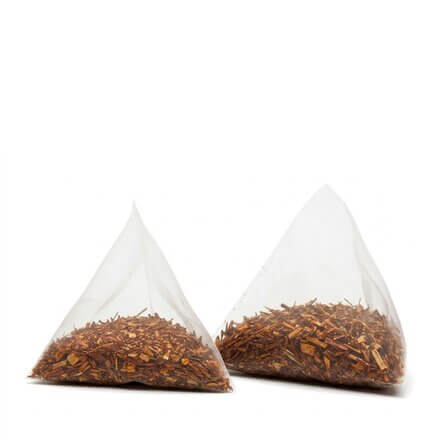
teabags
15 full leaf pyramids
$8
Lore
The South African native plant rooibos (Afrikaans for red bush) turns a rusty red color when the leaves are oxidized. It's also is a reddish color when brewed. When unoxidized, the tisane is called green rooibos. The plant (Aspalathus Linearis) grows only in the regions of the Cederberg Mountains where its aboriginals, the KhoiSan, have used rooibos as both a beverage and a medicinal for hundreds of years. In 1772, Swedish naturalist and botanist, Carl Peter Thunberg, aka Karl Peter von Thunberg, was the first to study rooibos and is now considered the father of South African botany.
Raw Honey for Rooibos
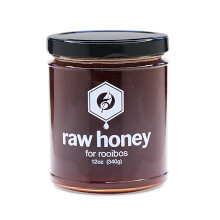
12oz
honey for rooibos & honeybush
$9
Part of red rooibos teas sampler
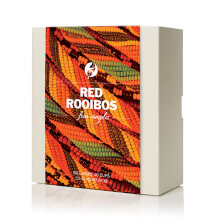
red rooibos teas
will make 40 cups
$14
Questions and Answers
Ask a question about rooibos and have the Adagio Teas community offer feedback.
Is it organic?
Asked by Shelli G
on December 25th, 2020
on December 25th, 2020
Direct Trade Advantage
We import directly from the artisan farmers whose names and faces you'll find throughout our website.
This makes our products fresher than those offered by the companies who use middlemen and brokers, and also less expensive.
Here's a comparison of how much more you'd be paying by buying this elsewhere:
David's Tea:
108% more expensive
Meet our rooibos farmer, Niklaas Jakobus Slinger
To ensure the best quality and value, we import our teas directly from the countries in which they are grown, working closely with the farmers who tender them. Our Roots Campaign connects our customers with the rich stories and the farmers behind some of our most popular teas.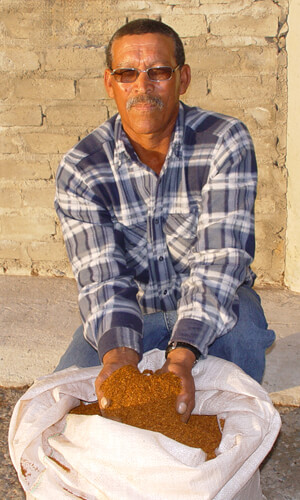
How long have you been growing tea?
“32 years. I started working as a laborer on a neighboring Rooibos Farm and for the past 14 years I have been growing Rooibos on my own farm.”
What got you started in the tea industry?
“I grew up on a Rooibos Farm. After I left home, I worked on different farms producing a wide variety of agricultural products, but my love for Rooibos and the area in which I grew up brought me back home. Since I was a small boy, I dreamed about owning my own Rooibos Farm and 14 years ago my dream came true with the help of my previous employer who helped me to loan money to purchase my own Rooibos farm.”
Can you describe a typical day out in the field? How many hours would that be?
“During Harvesting season (January - April), I leave home at 05:00 in the morning to turn the Rooibos fermentation heaps on the drying yard. I then go to the fields and start harvesting the Rooibos. At 10:00 I return to the drying yard to open the fermentation heaps and spread the Rooibos thin and evenly to dry. I then continue harvesting till we break for lunch at 12:30. After lunch (14:00) I take the harvested Rooibos to the drying yard for further processing. After cutting and bruising the tea is put into fermentation heaps around 18:00. After that we collect the dried Rooibos from the drying yard. My day ends at around 19:30. A typical working day is around 13 hours during harvesting season.”
What Is Rooibos Tea?
Rooibos Tea (Afrikaans: rooibos — "red bush") is a herbal infusion made from the leaves and stems of Aspalathus linearis — a shrub endemic to the Cederberg mountain region of South Africa's Western Cape province. It is not related to the tea plant (Camellia sinensis), contains no caffeine, and grows naturally only in a specific zone of the Cederberg Mountains — a relatively small geographical area where the specific combination of soil, altitude, and climate that Aspalathus linearis requires exists nowhere else on earth.
In South Africa, rooibos is simply "tea" — the default hot beverage consumed more widely than Camellia sinensis-based tea. Internationally, it is known variously as rooibos tea, red bush tea, red tea, and bush tea, all referring to the same plant and the same infusion. With a score of 93 from 1,318 customers, Adagio's Rooibos Tea is the foundation of the rooibos range — the pure, unflavoured expression of what rooibos tastes like before any blending or flavouring is applied.
The Cederberg Mountains: The Only Place on Earth Where Rooibos Grows
The geographical exclusivity of rooibos is one of the most remarkable facts about any beverage plant in the world. Aspalathus linearis grows wild and can be cultivated only in the Cederberg Mountains (Cedarberg) — a rugged mountain range approximately 200 kilometres north of Cape Town in the Western Cape province of South Africa. The specific combination of acidic, nutrient-poor, sandy soil (called "fynbos" biome soil), the altitude, the specific temperature range, and the seasonal rainfall pattern of the Cederberg creates growing conditions that exist only in this one place.
Multiple attempts to cultivate rooibos outside the Cederberg — in other South African provinces, in other countries with similar climates — have failed to produce commercially viable plants. The rooibos in every cup anywhere in the world was grown in the Cederberg. Adagio's Rooibos comes from this same limited growing region, sourced directly from farmers whose families have grown rooibos in this specific landscape for generations.
The KhoiSan and Rooibos: A Thousand Years Before Carl Thunberg
The Lore section places rooibos in two historical contexts: the KhoiSan people who used it for centuries, and the Swedish botanist who first documented it for Western science.
The KhoiSan (also written as Khoisan or Khoi-San) are the Indigenous people of southern Africa — one of the world's oldest continuous human populations, whose ancestors occupied the Cape region of South Africa for tens of thousands of years. The KhoiSan used rooibos both as a beverage and as a medicinal herb, a practice documented by early European settlers and explorers who encountered rooibos-drinking communities in the Cederberg region. The specific traditional uses varied, but the consistent documentation of both beverage and medicinal application places rooibos's human use history well before any European encounter.
In 1772, Swedish naturalist Carl Peter Thunberg became the first Western scientist to formally document Aspalathus linearis — and the Lore section notes his designation as "the father of South African botany," a title reflecting the comprehensive plant documentation he conducted during his Cape expedition. Commercial rooibos cultivation began in earnest only in the early 20th century, when a Russian immigrant named Benjamin Ginsberg began commercialising rooibos harvesting with local KhoiSan communities in the Cederberg.
Red Rooibos vs. Green Rooibos: The Oxidation Difference
The Lore section notes: "When unoxidized, the tisane is called green rooibos." This is worth understanding for buyers who encounter both styles:
- Red Rooibos (this product) — the traditional style. After harvesting and cutting, the rooibos is bruised and allowed to oxidise (ferment) in heaps — exactly as Niklaas Jakobus Slinger describes in his harvest account: "cutting and bruising the tea is put into fermentation heaps around 18:00." The oxidation process turns the leaves and stems from green to the characteristic rusty red-brown colour and develops the warm, earthy, sweet character that defines rooibos worldwide. Most rooibos available internationally is red rooibos.
- Green Rooibos — produced by immediately drying the freshly cut rooibos without the fermentation step, preserving the green colour and producing a lighter, more delicate, slightly more grassy character with more antioxidants retained from the unoxidised leaf. More expensive and less widely available than red rooibos.
Adagio's plain Rooibos Tea is the traditional red, oxidised style — the one that Niklaas Slinger's 13-hour harvest days and fermentation heaps produce. The rusty reddish-brown colour of the dry leaf and the deep red-amber of the brewed cup are the visual signatures of the oxidation process.
Rooibos Tea Flavour Profile
- Earthy and woody — the foundation of the cup. The Cederberg mountain shrub produces a warm, earthy, woody character that reviewers describe variously as "hay-like," "like taro," and "vanilla-like roastiness." It is not the sharp woodiness of bark or timber — a warm, dry, slightly sweet earthiness.
- Fruity sweetness — the product description's "slightly fruity" is accurate: a natural, background sweetness that does not require any added sugar or flavouring. The oxidation process develops this fruity quality, which is most noticeable as a warm, slightly honeyed dimension in the cup.
- Caramel and vanilla tones — reviewers frequently identify subtle caramel and vanilla qualities in quality rooibos, produced by the natural compounds developed during oxidation. These are the notes that make rooibos suitable for pairing with milk — the combination resembles a rooibos latte in a way that standard herbal teas do not.
- Smooth, no astringency — rooibos contains no tannins, which means it produces no mouth-drying astringency regardless of steep time. The product description's "very forgiving, it will not over-steep" is the most practically important quality claim: rooibos at 212°F for 10+ minutes does not become bitter. It simply becomes richer.
- Deep red-amber liquor — the visual signature. A beautiful, warm, deep red-amber colour that is immediately distinctive and immediately appetising. Unlike the pale gold of white tea or the yellow-green of Sencha — rooibos produces a rich, jewel-toned cup.
An Honest Profile: Who Pure Rooibos Is For
Like Toasted Mate, the review community's feedback on plain rooibos is candid: "polarized." This is worth acknowledging alongside the genuine enthusiasm:
Pure Rooibos is the right choice if you:
- Want the baseline experience of rooibos before deciding which flavoured version to explore — the sample ($3, 10 cups) is specifically designed for this purpose
- Appreciate earthy, woody, and slightly sweet flavour profiles — the same buyers who enjoy Hojicha, Toasted Mate, and aged pu-erh often find pure rooibos immediately appealing
- Want a caffeine-free base for creating your own blends — rooibos's neutrality, forgivingness, and flavour compatibility make it the most versatile caffeine-free base available
- Appreciate the flavour of taro, roasted sweet potato, or similar warm, earthy-sweet profiles
Pure Rooibos may not be the right first choice if you:
- Are new to rooibos — the flavoured versions in the Red Rooibos Teas Sampler (Rooibos Orange, Rooibos Peach, Rooibos Vanilla) are more immediately accessible and more likely to convert a first-time buyer to regular rooibos consumption
- Dislike woody, earthy, or "wet wood" flavour profiles — the detractors in the review community consistently identify these qualities; they are not brewing errors, they are the nature of plain rooibos
Rooibos as a Blending Base
The product description identifies rooibos as blending well with "nuts, herbs and fruits" — and the review community extends this significantly. Rooibos is uniquely suited as a caffeine-free blending base for several reasons:
- No astringency to clash with additions — without tannins, rooibos accepts flavour additions without the bitterness competition that occurs when you blend with black tea
- Warm earthy sweetness as a foundation — the natural sweetness and earthy warmth of rooibos amplifies rather than competes with vanilla, caramel, fruit, and spice additions; this is why the rooibos flavour range (orange, peach, vanilla, chai) tastes so natural
- Forgiving steep time — blending with rooibos doesn't require precise temperature or timing management; the blend extracts fully at any reasonable steep time without risk of bitterness
- Milk-compatible — rooibos takes dairy and plant milks well, making it the caffeine-free equivalent of a base tea for rooibos lattes
How to Brew Rooibos Tea
- Water temperature — 212°F (100°C), fully boiling. Rooibos is an herbal infusion — no tannins to over-extract, no caffeine to manage. Boiling water extracts the full earthy, fruity character.
- Leaf quantity — one heaping teaspoon (2–3g) per 8oz cup. The shredded stems and leaves are light; measuring generously produces the richest red cup.
- Steep time — 5 minutes minimum; can be extended to 7–10 minutes for a richer, deeper cup. The steep panel's note — "Rooibos is forgiving and can be steeped longer for a richer, smoother cup" — is the most important brewing guidance on the page. Unlike green or white tea, longer steeping is better for rooibos.
- With milk — rooibos accepts dairy and oat milk well, producing a warm, naturally slightly sweet rooibos latte. The caramel and vanilla tones in the rooibos develop further when combined with milk.
- With honey — Adagio carries a Raw Honey for Rooibos specifically matched to the fruity notes of rooibos and honeybush. The dark, floral honey amplifies the rooibos's own fruity sweetness.
- As a blend base — see the blending section above. Pure rooibos steeped at double strength (2 teaspoons per 4oz) makes an excellent base for iced rooibos latte blends.
Rooibos Tea Caffeine Content
Rooibos Tea contains zero caffeine — completely and genuinely caffeine-free. Aspalathus linearis is not related to the tea plant and produces no caffeine. The "No caffeine" panel's note — "Rooibos is naturally caffeine-free, making it a good choice for evenings or anyone avoiding caffeine" — is accurate and worth taking literally: rooibos at any strength, any steep time, produces no caffeine whatsoever. It is one of the few warm beverages with the depth and complexity of a true tea that is completely safe for evening and bedtime consumption and suitable for any buyer managing caffeine intake.
Rooibos Tea and the Red Rooibos Teas Sampler
Rooibos is one of four teas in the Red Rooibos Teas Sampler alongside Rooibos Orange, Rooibos Peach, and Rooibos Vanilla. In context, plain Rooibos is the reference point — the unflavoured baseline that shows what the other three teas are built on. Tasting plain rooibos alongside its flavoured versions demonstrates exactly how the natural earthiness and sweetness of the base supports orange, peach, and vanilla flavour additions. At $14 for 40 cups across four styles, the sampler is the most efficient introduction to the rooibos range. See the Red Rooibos Teas Sampler.
Rooibos Tea as a Gift
Rooibos is the most culturally specific and most origin-distinctive caffeine-free gift in the Adagio collection — the one with a childhood dream behind it (Niklaas Jakobus Slinger's farm), a geographically exclusive growing region (the only place on earth), a thousand-year human tradition (the KhoiSan), and a 5am harvest day that produces the 12¢/cup cup in the cup. For any recipient who is curious about caffeine-free alternatives to tea but hasn't encountered rooibos, this is the introduction that gives them the full story rather than simply a pleasant beverage.
Available in a sample ($3, 10 cups), 3oz ($8, 37 cups, 21¢/cup), 16oz ($24, 200 cups, 12¢/cup), and pyramid teabags ($8, 15 bags). The 3oz pouch at $8 is the ideal gift size. For the complete rooibos exploration, the Red Rooibos Teas Sampler at $14 includes plain Rooibos alongside Rooibos Orange, Rooibos Peach, and Rooibos Vanilla — the most efficient way to show a rooibos newcomer the full range of what this specific plant is capable of.
Buy Rooibos Tea Online
Order Rooibos loose leaf tea online — South African red bush tea from the Cederberg Mountains (Aspalathus linearis), naturally caffeine-free, scored 93 by 1,318 customers, from 12¢ per cup. Free shipping on qualifying orders. Available in sample, 3oz, and 16oz loose leaf pouches and pyramid teabag format. Delivered from Adagio's New Jersey warehouse within one business day.