Green Rooibos Tea is an herbal infusion made from the unoxidised leaves and stems of Aspalathus linearis — the same South African plant (commonly called red bush or rooibos) used to make traditional red rooibos, processed differently to produce a lighter, greener, more delicate cup. The plant grows only in the Cederberg Mountains of South Africa's Western Cape province and nowhere else on earth — the same geographic exclusivity that applies to its fermented counterpart.
Where red rooibos is defined by the fermentation (oxidation) process that turns its green plant material into the characteristic deep reddish-brown, green rooibos skips that step entirely. The leaves are harvested and then processed using heat treatment to deactivate the natural enzymes that would trigger oxidation — leaving the natural chlorophyll and the lighter, grassier, more delicate character of the fresh plant material intact. Green rooibos was first developed as a commercial product in 1995 by Infruitec, a division of South Africa's Agricultural Research Council — making it, despite the ancient heritage of the rooibos plant itself, a genuinely recent commercial innovation.
Every practical difference between green rooibos and red rooibos traces back to one variable: the fermentation (oxidation) step that red rooibos undergoes and green rooibos skips.
The analogy that helps: green rooibos is to red rooibos as green tea is to black tea. Same plant, different processing, fundamentally different character. The fermentation that produces black tea's depth and astringency produces red rooibos's earthy richness; the absence of fermentation that keeps green tea light and delicate produces green rooibos's grassy sweetness.
Adagio offers three distinct South African caffeine-free teas, each from a different plant or processing approach:
The practical guide: red rooibos for earthy depth; green rooibos for light, grassy delicacy; honeybush for natural honey sweetness. All three are caffeine-free, all three brew at 212°F, all three make excellent blending bases. Together they represent the full range of South African caffeine-free tea culture.
The Lore section notes that green rooibos "is not oxidized so its natural chlorophyll remains intact" — and this explains both the colour and much of the character difference from red rooibos:
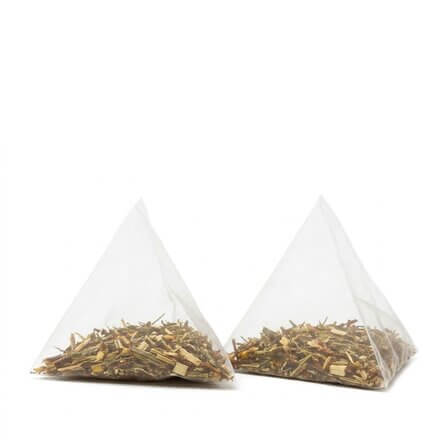
Chlorophyll (the green pigment responsible for photosynthesis in plants) degrades during the fermentation process that produces red rooibos. The cutting, bruising, and oxidation break down chlorophyll into non-green pigments, producing the characteristic amber-red colour. When oxidation is prevented — through the heat treatment that deactivates the relevant enzymes — the chlorophyll is preserved, giving green rooibos its distinctive golden-green colour in the dry leaf and the pale golden liquor in the cup.
The preserved chlorophyll also partially explains the flavour difference: the grassy, slightly vegetal character of green rooibos reflects the intact plant chemistry of the unoxidised leaf, including the aromatic compounds that would be transformed by fermentation into the earthier, nuttier character of red rooibos.
A buyer asked in the Q&A section: "What is the rooibos treated with to prevent oxidation?" The answer: no chemical treatment is used. Green rooibos is processed using heat — specifically, the freshly harvested plant material is subjected to a rapid heat treatment (steaming or similar thermal process) that deactivates the naturally occurring polyphenol oxidase enzymes in the leaf before they can catalyse the oxidation reaction. This is the same principle used in green tea production: Japanese Sencha uses steam, Chinese Dragonwell uses a hot wok, green rooibos uses an analogous heat treatment. No additives, no chemicals — just heat applied quickly enough to stop the enzyme activity before oxidation begins.
The review community's most consistent signal is that green rooibos converts buyers who find red rooibos too strong. The reviewer quote captures it: "I'm not a fan of traditional rooibos but this is it." Green rooibos delivers the caffeine-free, South African herbal tradition in a form that is lighter, sweeter, and less medicinal than the red version.
Green rooibos is the right choice if you:
Like its fermented counterpart, green rooibos excels as a blending base — but with a different blending profile than red rooibos:
Green Rooibos Tea contains zero caffeine — completely caffeine-free. The Aspalathus linearis plant produces no caffeine regardless of whether it is oxidised or not. The Lore section notes that green rooibos is "suitable for children, adults, and the elderly" — a cultural designation reflecting both the zero caffeine and the complete absence of bitterness and astringency, making it one of the most broadly accessible warm beverages available.
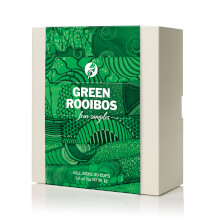
Green Rooibos is one of four teas in the Green Rooibos Teas Sampler alongside Green Rooibos Blueberry, Green Rooibos Bonita, and Green Rooibos Key West. The sampler demonstrates green rooibos's versatility as a blending base by pairing it with three distinctly different flavour profiles: berry-fruit (blueberry), tropical-floral (bonita), and citrus-tropical (key west). At $14 for 40 cups across four teas, the Green Rooibos Teas Sampler is the most efficient way to understand both the plain character and the blending potential of green rooibos.
Green Rooibos is the most unexpected and most intriguing South African herbal gift in the Adagio catalog — the tea that looks like nothing else (pale golden-green dry leaf, equally unusual liquor) and surprises buyers who come to it expecting red rooibos. The combination of the 1995-developed commercial history, the unoxidised plant science, the genuinely pleasant light-sweet character, and the zero caffeine makes it a gift with genuine depth for any recipient who drinks herbal tea.
Available in a sample ($3, 10 cups), 3oz ($9, 37 cups, 24¢/cup), 16oz ($29, 193 cups, 15¢/cup), and pyramid teabags ($9, 15 bags). The 3oz pouch at $9 is the ideal gift size. For the complete South African caffeine-free comparison, pair with Rooibos Tea — the same plant, fermented vs unfermented, demonstrating the full transformation that oxidation produces in a single ingredient.
Order Green Rooibos loose leaf tea online — unoxidised South African rooibos (Aspalathus linearis), naturally caffeine-free, scored 92 by 577 customers, from 15¢ per cup. Free shipping on qualifying orders. Available in sample, 3oz, and 16oz loose leaf pouches and pyramid teabag format. Delivered from Adagio's New Jersey warehouse within one business day.