Savor the exquisite aroma and rich flavor of our fujian ti kuan yin tea.
Ti Kuan Yin (鐵觀音, Tiě Guān Yīn) is one of China's ten most famous teas and one of the most internationally celebrated oolongs in the world. The name translates as "Iron Goddess of Mercy" — a reference to Guanyin (觀音, Kuan Yin), the Buddhist bodhisattva of compassion, one of the most venerated figures in Chinese, Japanese, Korean, and Vietnamese Buddhism. The "Iron" refers to the weight of the rolled tea leaves, which are heavier than other rolled oolong styles.
Ti Kuan Yin originates from Anxi county in Fujian province, southeastern China — a mountainous growing region whose specific combination of altitude, soil, and climate produces the tea's characteristic mineral character, floral depth, and the "warm, soothingly mineral" texture that the product description captures. It sits in the medium oxidation range of the oolong spectrum: more oxidised than Jade Oolong's light freshness, less than the darker Taiwanese oolongs used in Peach Oolong.
The origin legend of Ti Kuan Yin is one of the most beautiful stories in all of tea mythology — and unlike many origin legends, it is specific enough to feel like a memory rather than an invention:
A poor farmer in Fujian province maintained an old, dilapidated temple dedicated to Guanyin, the Iron Goddess of Mercy. He had little money but gave what he could — cleaning the temple, burning incense, tending the space with devotion despite receiving nothing in return. One night, Guanyin appeared to him in a dream.
"The key for your future," she told him, "is just outside this temple."
Outside, the farmer found a small seedling tea bush growing in a crack in the rock. He transplanted it, cared for it through years of cultivation, and eventually it grew "rich and full, with thick green leaves." The lovely tea from those leaves was shared with his neighbours and appreciated by all. The tea became known as Ti Kuan Yin — the Iron Goddess of Mercy's gift — and from that original seedling, the Anxi county Ti Kuan Yin tradition grew into one of the most celebrated tea styles in the world.
Whether the story is literally true is a question for theologians. What it communicates is real: Ti Kuan Yin is a tea that rewards patient care and devotion. The farmer in the legend maintained a temple for years without reward. Wang Mei Rui, the farmer behind Adagio's Ti Kuan Yin, works 19 hours a day during harvest season for over 30 years. The legend and the reality tell the same story.
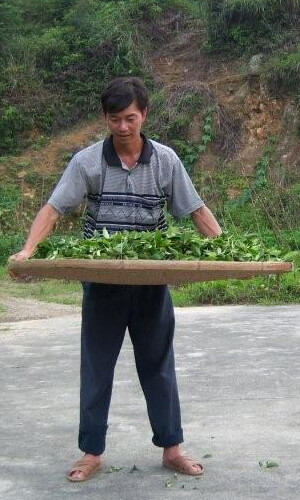
Like Jade Oolong's Xu Zheng Ren, Adagio's Ti Kuan Yin has a named, personally interviewed farmer: Wang Mei Rui, who has grown tea for more than 30 years in the Ti Kuan Yin growing tradition. In her own words from the Adagio Roots Campaign interview:
The product description notes that Ti Kuan Yin is "extremely time-consuming to produce — well over a dozen distinct steps in the processing." Wang Mei Rui's account makes that abstract claim viscerally specific: 5am start, mountain pick at 8–9am when the dew is just right, factory processing through bleachery (withering in sunlight), withering, rolling, and drying — 19 hours every day. This is the human reality behind a 40¢/cup tea.
The product description's characterisation of Ti Kuan Yin as "a meditative cup" is the most considered description in the oolong range — and worth unpacking:
Ti Kuan Yin is not a dramatic tea. It does not deliver the immediately vivid fruitiness of Peach Oolong, the pure floral freshness of Jade Oolong, or the honey-and-orchid opulence of Ali Shan. Its character is more subtle: the walnut and collard greens provide savoury depth; the orchid lingers rather than announces itself; the mineral texture warms rather than excites. To appreciate Ti Kuan Yin fully requires the kind of attention that the legend's farmer brought to the Guanyin temple — patient, unrewarded-seeming in the moment, but rewarded eventually by something that turns out to have been there all along.
The 195°F, 2–3 minute brewing parameters reinforce this character: too rushed and you miss the orchid finish; brewed with attention at the right temperature, the cup reveals itself completely. Ti Kuan Yin is the tea for mornings that haven't started yet, for the space between tasks, for the pause that makes the rest of the day possible. The legend named it well.
Where Ti Kuan Yin sits relative to the other oolongs in the Adagio collection:
The practical guide: Peach Oolong for fruit-forward accessibility; Jade Oolong for delicate florals; Ali Shan for honey and elevation; Ti Kuan Yin for meditative depth and the legendary name. Each represents a different answer to the question of what oolong can be.
The product description notes that Ti Kuan Yin requires "well over a dozen distinct steps in the processing" — more than almost any other tea category. The primary steps of Ti Kuan Yin production are:
Each of these steps requires precise timing, temperature control, and the accumulated knowledge that Wang Mei Rui's 30 years and her family's generational tradition provide. A batch of Ti Kuan Yin that goes wrong at step 5 cannot be saved at step 10. This is why the product description describes it as "extremely time-consuming" and why authentic Ti Kuan Yin commands a premium.
Ti Kuan Yin contains approximately 30–50mg of caffeine per 8oz cup — the moderate oolong range, consistent with medium oxidation and the 195°F, 2–3 minute brewing parameters. Each subsequent steeping produces somewhat less caffeine as extraction depletes. Appropriate for morning through early evening; the meditative character suits the reflective hours as much as the energising morning ones.
Ti Kuan Yin is the most historically and culturally resonant tea gift in the Adagio collection — the tea with a 1,000-year legend, a Buddhist bodhisattva's name, and a farmer who works 19 hours a day to produce it. For any recipient who appreciates the human and cultural depth behind what they drink, Ti Kuan Yin carries more story per gram than any other tea in the catalog.
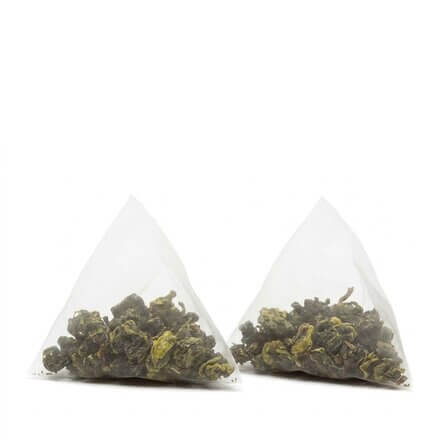
Available in a sample ($7, 10 cups), 3oz pouch ($24, 37 cups, 64¢/cup), 16oz pouch ($79, 197 cups, 40¢/cup), and pyramid teabags ($24, 15 bags). The 3oz pouch is the right gift size. For the most instructive oolong comparison, pair with Jade Oolong — the two teas from different Chinese oolong traditions (Fujian medium-oxidised Ti Kuan Yin vs Taiwan light-oxidised Jade) demonstrate more about the oolong spectrum than any written description can.
Order Ti Kuan Yin loose leaf tea online — the Iron Goddess of Mercy oolong from Anxi county, Fujian province, China, scored 94 by 987 customers, from 40¢ per cup. Free shipping on qualifying orders. Available in sample, 3oz, and 16oz loose leaf pouches and pyramid teabag format. Delivered from Adagio's New Jersey warehouse within one business day.