93
white monkey tea
based on 1317 reviews
Your savings will grow with each shipment. Save 5% now, and up to 15% in the future. Please select size:
sample
makes 5 cups
$3
1.5oz
48¢ per cup
$9
8oz
29¢ per cup
$29
teabags
15 full leaf pyramids
$9
White Monkey (白毛猴, Bái Máo Hóu — "White Hairy Monkey") is a green tea grown along the slopes of the Taimu mountains (太姥山) in the Fujian province of China. Do not be confused by the name — the young leaves and unopened buds are carefully gathered and processed exclusively by hand, and the result is a tea that appears intricately woven with large, beautiful white tips that resemble white-haired monkey's paws, hence the name.It produces a warm-colored cup with a fresh and subtly seaweedy aroma infused with delicate sweetness, a buttery silky mouthfeel, and a slightly dry finish.

TEA TYPE
Green Tea

CAFFEINE
Moderate
Green tea usually offers a gentler lift than black tea or coffee, with enough caffeine for a light, refreshing boost.

STEEP
180° for 2-3 mins
Use the shorter steep for a smoother cup; over-steeping may taste bitter.
Customer Reviews (1317)
Teabags
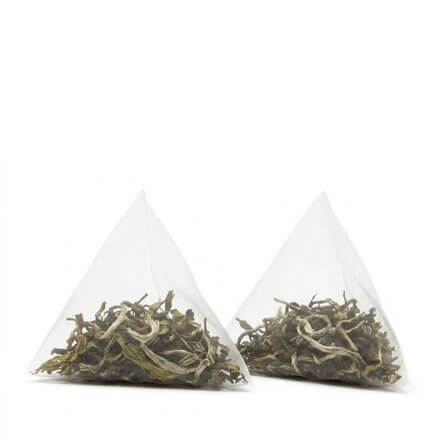
teabags
15 full leaf pyramids
$9
Lore
If you visit a hot spring in the colder regions of Japan, you might have the curious experience of sharing your onsen (hot spring) with a monkey. Because of the frosty environment they inhabit, Japanese macaques, or "snow monkeys" have become known for their frequent visits to the springs, such as the Jigokudani hot spring in Nagano. The iconic primates have also influenced Japanese culture, inspiring the three wise monkeys of "see no evil, hear no evil, speak no evil" fame and depictions of monkeys related to the Chinese zodiac. One other possible inspiration? This delicious green tea.
Questions and Answers
Ask a question about white monkey and have the Adagio Teas community offer feedback.
How many grams of this tea would you suggest I use for gongfu brewing?
Asked by Deanna Sawyer
on May 4th, 2024
on May 4th, 2024
Meet our white monkey farmer, Yao Yi Lin
To ensure the best quality and value, we import our teas directly from the countries in which they are grown, working closely with the farmers who tender them. Our Roots Campaign connects our customers with the rich stories and the farmers behind some of our most popular teas.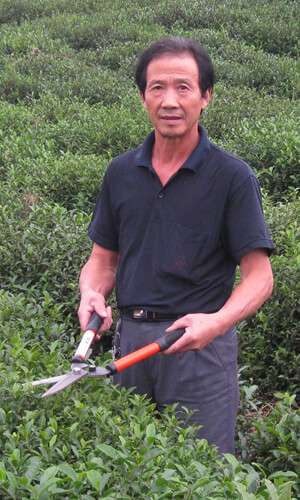
How long have you been growing tea and what got you started?
“It is a family business. I started to help my parents when I was very young. I have worked in tea for more than 30 years.”
Can you describe a typical day out in the field?
“In spring we are very busy because white monkey is a spring tea. I normally get up at 6 and go out to pick the fresh tea leaves. In the afternoon and evening we will make the teas with what we picked up in the day time. We never use yesterday's tea leaves to make this tea. So in spring time I will work more than 18 hours a day. After that, my main job is to fertilizing, weeding and making the field friable in the rest of the year.”
What is your favorite part of growing tea?
“I like picking in early fresh spring morning. I do enjoy the beautiful mountain at that time.”
What Is White Monkey Tea?
White Monkey Tea (白毛猴, Bái Máo Hóu) is a premium hand-processed green tea from the Taimu mountains (太姥山) of Fujian province, China. The name translates directly as "White Hairy Monkey" — not a marketing invention but a descriptive reference to the physical appearance of the finished tea: large, curled leaves woven with prominent white downy tips that resemble, in the imagination of whoever first named this tea, the hairy paws of a white-furred monkey.
White Monkey is a spring tea — produced exclusively from the year's first flush of new growth, when the young leaves and unopened buds are at their most tender and their white down is most visible. The "Bai" (白, white) in the name refers specifically to these white tips, which are the same fine silvery-white down found on the bud tips of white tea, appearing here on a green tea processed from the same tender spring growth.
The Taimu Mountains: Why This Location Produces This Tea
White Monkey grows along the slopes of the Taimu mountains (太姥山), a range in Fujian province known in Chinese culture as one of the most beautiful mountain landscapes in southeastern China — celebrated in classical poetry and famous among Taoist and Buddhist traditions as a site of spiritual significance. The elevation and mountain conditions of the Taimu range produce the specific growing environment that White Monkey requires:
- High altitude — the elevation slows tea plant growth, concentrating the natural amino acids and aromatic compounds in the young spring leaves. The slow-grown tip material is the source of the prominent white down and the characteristic silky mouthfeel.
- Mountain mist and humidity — the Taimu range's characteristic morning mist diffuses sunlight similarly to the way Gyokuro's shade covers work, preserving amino acid content at the expense of catechin development. Lower catechins mean lower bitterness and astringency; higher amino acids mean more umami and sweetness.
- Spring harvest only — White Monkey is produced exclusively from the first flush, when the Taimu mountain conditions are at their most specific combination of cool temperature, morning moisture, and tender new growth. The season is short; the window for the white-tipped spring buds is narrow.
Why "White Monkey"? The Name Behind the Tea
The product description addresses the naming question directly — "do not be confused by its name" — and the Lore section deepens it with the Japanese snow monkey connection. The name White Monkey has both a practical and a cultural dimension:
The practical origin: The finished tea, when correctly processed, contains large, curled leaves intricately woven with prominent white-silver downy tips. Viewed as a pile of loose leaf, the combination of the twisting green leaf and the white hairy tips can indeed suggest, to the right imagination, a collection of miniature white-furred paws. Tea names in the Chinese tradition often describe the physical appearance of the leaf — Dragon Well for Longjing's flat sword shape, Silver Needle for white tea's thin bud tips, Gunpowder for the rolled pellets. White Monkey follows the same tradition.
The Lore connection: The Lore section links the name to the Japanese snow monkey (Macaca fuscata), whose winter visits to hot springs — most famously the Jigokudani onsen in Nagano — have made the image of a white-furred primate in warm water one of the most internationally recognised images of Japan. The three wise monkeys ("see no evil, hear no evil, speak no evil") and the monkey of the Chinese zodiac provide additional layers of cultural resonance. The tea's name — whether or not it was consciously connected to these traditions — lands in a rich context of monkey-related symbolism across both Chinese and Japanese culture.
White Monkey Tea Flavour Profile
- Savory umami — the dominant quality that reviewers consistently identify. A deep, smooth, savoury depth that sits closer to the umami of quality Japanese Gyokuro than to the lighter, more purely aromatic character of standard Chinese green teas. The mountain terroir and same-day processing together preserve the amino acid richness that produces this character.
- Gentle seaweed/vegetal — a clean, oceanic-adjacent note beneath the umami. Reviewers compare it to seaweed, clean grass, and fresh vegetables — the green signature of a high-quality Chinese hand-processed spring tea without grassiness or sharpness.
- Nutty and malty touches — a warm, slightly roasted background dimension that provides depth beneath the umami and vegetal character. Not the assertive toastiness of Hojicha or Dragonwell — a subtler background warmth.
- Light florals — a delicate, occasional floral note that reviewers identify in careful brews. Not as assertive as jasmine or osmanthus — a background freshness that the spring bud material contributes.
- Buttery, silky mouthfeel — the most consistently praised textural quality. The combination of the high amino acid content from the mountain growing conditions and the same-day processing produces a smooth, coating mouthfeel that reviewers describe as buttery and silky — one of the most pleasant textures in the Chinese green tea range.
- Minimal astringency — at 180°F and 2–3 minutes, White Monkey has very low astringency. The high mountain growing conditions reduce catechin concentration (as with Gyokuro's shade-growing, altitude achieves a similar effect through slower growth); the same-day processing preserves the natural smoothness before oxidation can develop any harshness.
White Monkey vs. Adagio's Chinese Green Teas
- White Monkey / Bai Mao Hou (scored 93, 1,317 reviews, from 29¢/cup) — hand-processed, Taimu Mountain spring flush, same-day processing. Umami, seaweed, buttery silky. The most umami-rich and most artisanally produced Chinese green tea in the Adagio range. 180°F, 2–3 minutes.
- Dragonwell (scored 94, 1,294 reviews, from 45¢/cup) — pan-fired flat leaf, Hangzhou. Toasty white corn, nutty, buttery. The most famous Chinese green tea. 180°F, 2–3 minutes. See Dragonwell.
- Hunan Gold (scored 94, 483 reviews, from 39¢/cup) — yellow-style, Hunan province. White grape, pear, gentle florals. More fruit-forward, more delicate. 180°F, 2–3 minutes. See Hunan Gold.
- Gunpowder (scored 94, 2,871 reviews, from 15¢/cup) — pan-fired rolled pellets, Zhejiang. Full-bodied, slightly smoky. Most accessible. 180°F, 2–3 minutes. See Gunpowder Tea.
White Monkey sits closest to Gyokuro in flavour register — both prioritise umami and buttery smoothness — but White Monkey is Chinese, unshaded, fully green, and processes to a visually distinctive curled white-tipped leaf rather than Gyokuro's flat needle style. For a buyer who loves Gyokuro's smooth umami in a Chinese context, White Monkey is the most direct equivalent in the Adagio catalog.
How to Brew White Monkey Tea
- Water temperature — 180°F (82°C). Below boiling, like all Chinese green teas in the Adagio catalog. The high amino acid content and delicate spring bud material both benefit from below-boiling water. Reviewers note better results at the lower end of the range (165–175°F) for maximum smoothness.
- Leaf quantity — one teaspoon (2–3g) per 8oz cup. The large, curled, white-tipped leaves are light; measure by weight for the most consistent results.
- Steep time — 2–3 minutes. The product panel warns "over-steeping may taste bitter." Two minutes produces the most vivid buttery umami character; three minutes develops more body and brings the dry finish forward.
- Multiple steepings — White Monkey yields 3–4 quality steepings. The umami and seaweed character is most vivid in the first steep; the second steep shows more of the clean, slightly sweet base character; the third is lighter and more delicately floral.
- Glass vessel — recommended to appreciate the visual quality of the leaves. White Monkey's large, curled, white-tipped leaves opening in hot water is one of the most visually interesting steeping experiences in the Chinese green tea range. The warm golden-amber colour of the brewed cup is also distinctive and worth seeing clearly.
- Plain — no milk, no sweetener. The umami and buttery mouthfeel are entirely the tea's own; anything added would obscure the specific quality that makes White Monkey what it is.
White Monkey Tea Caffeine Content
White Monkey contains approximately 25–45mg of caffeine per 8oz cup — the standard moderate Chinese green tea range. The spring flush bud-heavy composition means the leaf material is naturally higher in caffeine concentration than later-flush material (young buds concentrate caffeine as an insect deterrent), but the 180°F, 2–3 minute brewing parameters produce moderate extraction. L-theanine content is elevated in the high-altitude spring flush material, providing the characteristic smooth energy that experienced green tea drinkers associate with quality spring teas. Appropriate for morning through early afternoon.
White Monkey Tea as a Gift
White Monkey is the most artisanally compelling Chinese green tea gift in the Adagio collection — the tea with the best story (Yao Yi Lin's 18-hour spring days, the same-day processing commitment), the most visually distinctive dry leaf (large curled leaves woven with white monkey-paw tips), and the most surprisingly umami-rich flavour for a green tea. For any recipient who appreciates artisanal production and has never encountered Bai Mao Hou, this is the gift that generates the most genuine curiosity and the most specific follow-up questions.
Available in a sample ($3, 5 cups), 1.5oz ($9, 18 cups, 48¢/cup), 8oz ($29, 100 cups, 29¢/cup), and pyramid teabags ($9, 15 bags). The 1.5oz pouch at $9 is the ideal gift size — the white-tipped curled leaves are immediately visually striking on opening, the fragrance is distinctive, and the price makes generous gifting practical. Pair with Dragonwell Tea for the most instructive Chinese green tea comparison — both are Fujian-region hand-processed spring teas expressing completely different character through different processing approaches.
Buy White Monkey Tea Online
Order White Monkey loose leaf tea online — Bai Mao Hou hand-processed spring green tea from the Taimu mountains, Fujian province, China (白毛猴), scored 93 by 1,317 customers, from 29¢ per cup. Free shipping on qualifying orders. Available in sample, 1.5oz, and 8oz loose leaf pouches and pyramid teabag format. Delivered from Adagio's New Jersey warehouse within one business day.