94
gyokuro tea
based on 929 reviews
Your savings will grow with each shipment. Save 5% now, and up to 15% in the future. Please select size:
sample
makes 5 cups
$9
4oz
68¢ per cup
$34
16oz
42¢ per cup
$84
teabags
15 full leaf pyramids
$34
Gyokuro (玉露, gyokuro — "jade dew") is a shade-grown steamed green tea from Japan, considered among the finest of all Japanese teas. While the young leaves of the spring season develop, Gyokuro plants are shaded from the sun for three to four weeks using covers called Komo. This deliberate light deprivation slows leaf growth and transforms the tea's character completely: the sun-deprived leaves produce more chlorophyll — explaining their vivid, deep green colour — and significantly more amino acids, most notably L-theanine, which accounts for Gyokuro's perfectly smooth, rich, and soft flavour that is unlike any unshaded green tea.
Our fine Gyokuro produces a deeply sweet aroma of freshly buttered greens and seaweed — not grassiness, not harshness, nothing sharp. Think of tender new grass just sprouting in the spring. Soft on the palate with a rich umami quality, balanced delicate finish, and a silky mouthfeel that reviewers consistently describe as the smoothest green tea they have encountered. Energising and soothing simultaneously.
Our fine Gyokuro produces a deeply sweet aroma of freshly buttered greens and seaweed — not grassiness, not harshness, nothing sharp. Think of tender new grass just sprouting in the spring. Soft on the palate with a rich umami quality, balanced delicate finish, and a silky mouthfeel that reviewers consistently describe as the smoothest green tea they have encountered. Energising and soothing simultaneously.

TEA TYPE
Green Tea

CAFFEINE
Moderate
Green tea usually offers a gentler lift than black tea or coffee, with enough caffeine for a light, refreshing boost.

STEEP
165° for 2-3 mins
Use the shorter steep for a smoother cup; over-steeping may taste bitter.
Customer Reviews (929)
Teabags
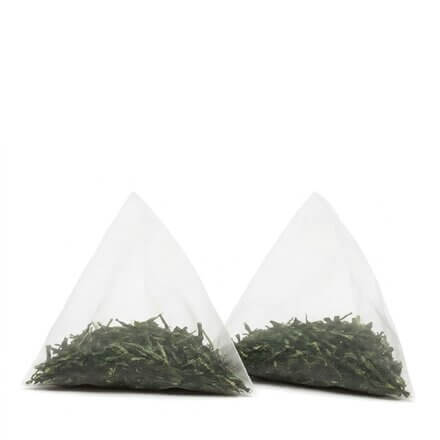
teabags
15 full leaf pyramids
$34
Lore
In Japan, tea is typically grown in two ways. The first is uncovered, which is similar to how most teas are grown. This method results in teas like Sencha, Bancha, and Hojicha. The other method is shade grown, which results in teas used for Matcha, Tencha, Gyokuro, and Kabuse. So, what's the difference between them? It all depends on how long the tea is covered, with Matcha and Tencha teas covered longest, then Gyokuro, and finally Kabuse. Shade grown teas are known for their increased chlorophyll, theanine, and amino acids, and are considered some of Japan's finest teas.
Questions and Answers
Ask a question about gyokuro and have the Adagio Teas community offer feedback.
How does Gyokuro compare to sencha(overture) in taste?
Asked by Chad Thompson
on January 25th, 2020
on January 25th, 2020
How much water is needed for proper brewing? I've been using 8 oz per packet, but some teas seem very weak.
Asked by Rebecca M
on July 3rd, 2020
on July 3rd, 2020
What exactly does 'multiple infusions' mean in relation to this tea?
Asked by Patricia Roker
on May 9th, 2024
on May 9th, 2024
Direct Trade Advantage
We import directly from the artisan farmers whose names and faces you'll find throughout our website.
This makes our products fresher than those offered by the companies who use middlemen and brokers, and also less expensive.
Here's a comparison of how much more you'd be paying by buying this elsewhere:
David's Tea:
111% more expensive
Meet our gyokuro farmer, Nagashima Takehisa
To ensure the best quality and value, we import our teas directly from the countries in which they are grown, working closely with the farmers who tender them. Our Roots Campaign connects our customers with the rich stories and the farmers behind some of our most popular teas.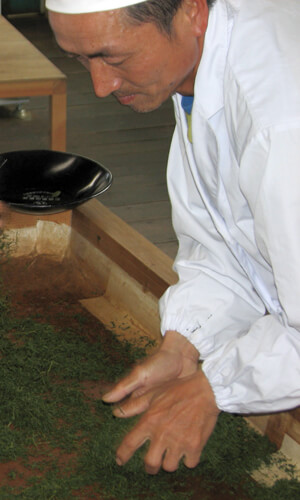
How long have you been growing tea?
“About 50 years. I have been involved in agriculture, especially in green tea fields ever since I graduated from an agricultural high school.”
What got you started in the Tea industry?
“I was the firstborn son of a green tea farming family, so it was a natural choice. Mainly I have been growing green tea, and I also grow Gyokuro.”
Can you describe a typical day out in the field. How many hours would that be?
“To growing Gyokuro, we start out by making shade coverings called "Komo" which is made of black polyester mesh. When green tea bushes' buds start coming out in April, we start putting covering on the frames over the tea bushes. After about 10 days, we cover with two layers, and cut the sun rays by 95%, and we pick them in 20 days.
We pick them by hand, so an adult could only pick 10kg of tea leaves working from 6AM till 6PM. Then finished tea will come out only 2kg. We cannot pick tea leaves on rainy days. After air-dry the leaves in bamboo containers, we start processing them 5AM next morning.”
We pick them by hand, so an adult could only pick 10kg of tea leaves working from 6AM till 6PM. Then finished tea will come out only 2kg. We cannot pick tea leaves on rainy days. After air-dry the leaves in bamboo containers, we start processing them 5AM next morning.”
What Is Gyokuro Tea?
Gyokuro (玉露) is a premium Japanese green tea produced through a shade-growing method that fundamentally changes the character of the tea leaf before it is ever harvested. The name translates as "jade dew" (玉 = jade, 露 = dew) — a name that captures both the vivid green colour and the cool, luminous, dew-like quality of the brewed cup.
While most of the world's tea is grown in full sunlight, Gyokuro plants are covered and shaded from direct sun for three to four weeks before the spring harvest. This practice — one of the most distinctive in Japanese tea agriculture — forces the plant to redirect its energy from producing catechins (bitter compounds stimulated by sunlight) to producing amino acids, particularly L-theanine. The result is a tea that is simultaneously richer, sweeter, more umami, and less bitter than any full-sun Japanese green tea of equivalent origin quality.
The Japanese Shading Spectrum: Where Gyokuro Sits
Japan grows tea in several shading configurations, each producing a different style. Understanding where Gyokuro falls clarifies what makes it exceptional:
- Matcha / Tencha — covered longest, typically 20–30 days. The most extreme shading, producing the highest amino acid and chlorophyll concentration. Ground into powder for matcha.
- Gyokuro — covered for approximately 20 days. The second most intensely shaded style. Harvested as whole leaves rather than ground. The premium loose leaf shade-grown green tea of Japan.
- Kabuse — covered for a shorter period, approximately 7–14 days. Produces a character between Gyokuro and Sencha.
- Sencha — uncovered, grown in full sun. Japan's most commonly consumed green tea. Brighter, more astringent, and more grassy than Gyokuro — excellent in its own right but a different category entirely.
This spectrum explains why Gyokuro is positioned as Japan's finest loose leaf green tea: it receives the most intensive shade treatment of any whole-leaf Japanese green tea, and the flavour it produces as a result — deeply sweet, umami-rich, smooth — is the direct expression of that agricultural intensity.
The Science Behind Gyokuro's Flavour: Shade, Theanine, and Umami
Gyokuro's unusual flavour profile — sweet, umami-rich, smooth, with no grassiness or astringency — has a specific biochemical explanation rooted in what shade does to the tea plant:
- Reduced photosynthesis — shade blocks the sunlight that drives photosynthesis. With less light energy available, the plant produces fewer catechins (the polyphenols responsible for green tea's bitter and astringent qualities). Less catechin = less bitterness = smoother cup.
- Elevated L-theanine — L-theanine (an amino acid found almost exclusively in tea) accumulates in the leaf when the plant cannot convert it into catechins through the normal sunlight-driven pathway. Higher L-theanine produces the characteristic umami quality — the savoury, smooth, rounded depth that makes Gyokuro taste unlike any other green tea.
- Increased chlorophyll — shaded leaves produce more chlorophyll to capture what little light penetrates the Komo covers. The result is the vivid, deep green colour of the dry Gyokuro leaf and the intensely green-coloured brew. Chlorophyll itself contributes to the fresh, grassy-sweet aroma without producing bitterness.
- Concentrated sugars — the slowed growth forces natural sugars to accumulate in the leaf rather than being converted rapidly through photosynthesis. This produces the natural sweetness and "buttered greens" aroma quality that the product description captures.
Gyokuro Flavour Profile
- Umami — the defining quality. Gyokuro has more pronounced umami than any other Japanese green tea — a savoury, smooth, rounded depth that resembles the umami of high-quality Japanese dashi broth more than it resembles standard green tea. This is the quality that surprises first-time Gyokuro drinkers most consistently.
- Buttered greens — the most evocative aroma descriptor for Gyokuro's character: the warm, rich, slightly fatty aroma of cooked dark leafy greens with butter. Not grassy — cooked, warm, sweet.
- Seaweed — a distinct oceanic, marine quality that sits alongside the umami. The same glutamate compounds that produce umami in kelp and nori (Japanese seaweeds) are also elevated in Gyokuro. For buyers unfamiliar with this quality, it is the most surprising aspect of Gyokuro; for those who appreciate umami, it is the most sought-after.
- Fresh summer rain — the review summary's most poetic flavour note: a clean, slightly humid freshness that keeps the cup from feeling heavy despite its richness.
- No bitterness, no grassiness — the most practically important quality. Standard green teas — including most Sencha — are brewed at higher temperatures and contain more catechins, which produces the familiar green tea bitterness and grassy sharpness. Gyokuro at 165°F has neither.
- Silky mouthfeel — the L-theanine and amino acid content produce a coating, silky texture that persists through the cup and into the finish. The most consistently noted review quality alongside the umami character.
Gyokuro vs. Sencha: Japan's Two Great Green Teas
The most common comparison for Gyokuro buyers:
- Gyokuro (scored 94, 929 reviews, from 42¢/cup) — shade-grown, 20 days of Komo covering. Deep umami, seaweed, buttered greens, silky smooth. No bitterness. 165°F, 2–3 minutes. Japan's finest and most labour-intensive loose leaf green tea.
- Sencha — full-sun grown. Brighter, lighter, more grassy and astringent. More caffeinated at equivalent steeping. Japan's everyday green tea, consumed in far greater volume than Gyokuro but at a lower quality ceiling.
The practical guide: Gyokuro for a tea that requires attention and rewards it with exceptional smoothness and depth; Sencha for a daily, more casual green tea with a brighter, grassier character. Many serious Japanese green tea drinkers keep both: Gyokuro for the mornings and moments that merit its full experience; Sencha for the everyday cup. See Adagio's full green tea collection for both.
Why Gyokuro Brews at 165°F — The Lowest Temperature in the Adagio Catalog
At 165°F (74°C), Gyokuro is brewed at the lowest temperature of any tea in the Adagio catalog — 15°F below Jade Oolong's 180°F, 30°F below Ali Shan's 195°F, and 47°F below boiling. This is not caution — it is the specific requirement of the L-theanine-rich, catechin-reduced leaf that Gyokuro's shade-growing produces.
The relationship between temperature and flavour compounds in Gyokuro:
- At 165°F — L-theanine and amino acids extract efficiently, producing the smooth, sweet, umami character. Catechins extract slowly, producing almost no bitterness. The Gyokuro character is fully delivered.
- At 180°F — catechin extraction accelerates. Mild bitterness begins to compete with the umami. Still drinkable but less refined.
- At 212°F (boiling) — catechins extract aggressively. The bitterness overwhelms the L-theanine and umami completely. The resulting cup bears no resemblance to proper Gyokuro. This is the most common Gyokuro brewing mistake.
In practice: a variable temperature kettle set to 165°F is the ideal tool. Without one, boil water and allow it to cool for 8–10 minutes before pouring — the temperature will typically drop to 160–170°F during that rest. The patience is worth it.
How to Brew Gyokuro Tea
- Water temperature — 165°F (74°C). The most critical brewing parameter for any tea in the catalog. See the section above for why.
- Leaf quantity — one teaspoon (2–3g) per 3–4oz of water. Gyokuro is traditionally brewed with less water than most teas — the small volume at low temperature concentrates the umami character rather than diluting it. A smaller vessel (chawan or yunomi) is the right tool.
- Steep time — 2–3 minutes. The product panel warns "over-steeping may taste bitter" — accurate at any temperature, but particularly important at 165°F where the extraction is slow and the balance between amino acids and catechins is calibrated to this specific time range.
- Multiple steepings — Gyokuro yields 3–4 quality steepings, with each revealing different dimensions. First steep: the full umami and buttered greens. Second steep: lighter, with the seaweed and mineral character more forward. Third steep: delicate, clean, and more purely sweet.
- Traditional small-vessel approach — serious Gyokuro brewing uses a small teapot (kyusu) or lidded bowl and pours concentrated amounts (2–3oz) rather than the standard 8oz Western cup. This concentrates the amino acid character and allows the full umami depth to be experienced without dilution.
- Plain, always — no milk, no sugar. Gyokuro's umami, sweetness, and silky mouthfeel are entirely the product of the shade-growing and careful brewing; anything added suppresses rather than complements.
Gyokuro Tea Caffeine Content
Gyokuro contains approximately 35–60mg of caffeine per 8oz equivalent — toward the higher end of green tea's range, because the shade-growing that reduces catechins and increases L-theanine also concentrates caffeine in the leaf. Gyokuro is actually higher in caffeine per gram of dry leaf than most Sencha or standard green teas. However, the low brewing temperature (165°F) and smaller brewing volume mean that the caffeine extraction per cup is more moderate than the dry leaf caffeine content suggests. The L-theanine content — among the highest of any tea — also moderates the stimulant effect of the caffeine, producing the "energising and soothing" quality the product description captures: alert without jitteriness.
Gyokuro Tea as a Gift
Gyokuro is the most prestigious Japanese green tea gift in the Adagio catalog — the tea that represents the apex of Japanese shade-growing tradition, backed by the story of Nagashima Takehisa's 50-year family farming heritage and the Komo shade structures he builds every April. For any recipient who appreciates Japanese tea culture, or who drinks green tea regularly and has never encountered Gyokuro's umami depth, this is the most genuinely revelatory gift in the green tea range.
Available in a sample ($9, 5 cups), 4oz ($34, 50 cups, 68¢/cup), 16oz ($84, 200 cups, 42¢/cup), and pyramid teabags ($34, 15 bags). The 4oz pouch is the right gift size for a serious introduction — enough for the recipient to explore multiple steepings at multiple temperatures and discover what 165°F produces compared to their usual green tea brewing approach. Pair with a variable temperature kettle for a complete gift that enables the specific brewing parameters this tea requires.
Buy Gyokuro Tea Online
Order Gyokuro loose leaf tea online — shade-grown premium Japanese green tea (玉露), scored 94 by 929 customers, from 42¢ per cup. Product of Japan. Free shipping on qualifying orders. Available in sample, 4oz, and 16oz loose leaf pouches and pyramid teabag format. Delivered from Adagio's New Jersey warehouse within one business day.