94
gunpowder tea
based on 2871 reviews
Your savings will grow with each shipment. Save 5% now, and up to 15% in the future. Please select size:
sample
makes 10 cups
$3
4oz
24¢ per cup
$12
16oz
15¢ per cup
$29
portions
Teforia-ready
$9
teabags
15 full leaf pyramids
$12
Gunpowder Tea (珠茶, zhū chá — "pearl tea") is a classic Chinese green tea from Zhejiang province, China, where it has been produced for over a thousand years. The leaves are hand-rolled into tiny, tightly compacted pellets that resemble gunpowder — giving this tea its Western name, coined in the 17th century when European traders first encountered the rolling style. The pellets unfurl dramatically in hot water, opening into full leaves and releasing a full-bodied cup with a distinct hint of smokiness and a smooth, buttery mouthfeel.
One of the most versatile green teas in our collection: excellent plain, exceptional as the traditional base for Moroccan Mint tea when blended with fresh or dried spearmint. The combination of Gunpowder's full body and slight smoke with mint's brightness is the foundation of one of the world's most widely drunk tea traditions.
One of the most versatile green teas in our collection: excellent plain, exceptional as the traditional base for Moroccan Mint tea when blended with fresh or dried spearmint. The combination of Gunpowder's full body and slight smoke with mint's brightness is the foundation of one of the world's most widely drunk tea traditions.

TEA TYPE
Green Tea

CAFFEINE
Moderate
Green tea usually offers a gentler lift than black tea or coffee, with enough caffeine for a light, refreshing boost.

STEEP
180° for 2-3 mins
Use the shorter steep for a smoother cup; over-steeping may taste bitter.
Customer Reviews (2871)
Teabags
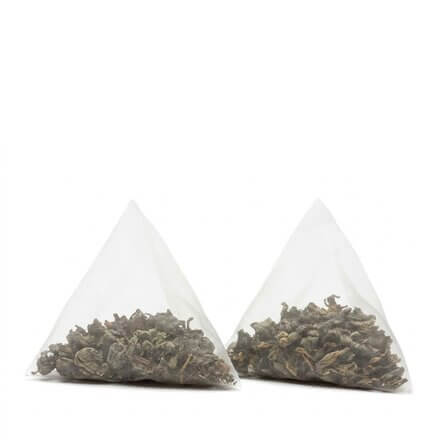
teabags
15 full leaf pyramids
$12
Fresh Portions
gunpowder
portions
Teforia-ready
$9
Lore
Gunpowder is the world's oldest known chemical explosive. Made from sulfur, charcoal, and saltpeter, it is one of the Four Great Inventions of China, alongside the compass, paper-making, and printing. Though it's famous for its use in weaponry like guns and cannons - spawning countless movie scenes of exploding barrels or chases to snuff out sparking black lines, it was also used for more constructive purposes like mining and even medicine. Though Gunpowder tea doesn't carry quite the same explosive punch as its namesake, it is famous for its smokiness and shape, both of which lend themselves to its unique name.
Questions and Answers
Ask a question about gunpowder and have the Adagio Teas community offer feedback.
bags or cans
Asked by Lawrence Fields
on September 12th, 2017
on September 12th, 2017
Is this a fair trade tea?
Asked by Frances Bennett
on August 8th, 2020
on August 8th, 2020
what tea plant is used to make gunpowder tea
Asked by Richard Dent
on January 12th, 2025
on January 12th, 2025
What Is Gunpowder Tea?
Gunpowder Tea (珠茶, zhū chá) is a style of Chinese green tea produced by hand-rolling the processed leaves into tight, small, spherical pellets — a production method that originated in Zhejiang province during the Tang Dynasty (618–907 AD) and has been practiced continuously for over a thousand years. The Chinese name, 珠茶 (zhū chá — "pearl tea"), describes the round, lustrous appearance of the rolled pellets. The English name "Gunpowder" was coined by 17th century European traders who encountered the pellets and found that their shape, grey-black colour, and slight sheen resembled the granular gunpowder used in firearms of the period.
The rolling process is the defining characteristic of Gunpowder Tea and the source of everything distinctive about it: the shape, the full-bodied flavour, the hint of smokiness, and the dramatic unfurling in hot water that reviewers consistently describe as one of the most visually satisfying moments in Chinese green tea brewing.
Gunpowder: One of the Four Great Inventions of China
The Lore section makes a connection that is both historically accurate and genuinely interesting: the gunpowder this tea is named for is one of China's Four Great Inventions (四大發明, sì dà fāmíng) — the quartet of technologies that historians identify as China's most consequential contributions to world civilisation, alongside the compass, paper-making, and printing.
The actual gunpowder — the chemical explosive made from sulfur, charcoal, and saltpeter (potassium nitrate) — was discovered by Chinese alchemists during the Tang Dynasty, initially as a byproduct of attempts to develop an immortality elixir. The first recorded formula appears in the 9th century. It was used for centuries in Chinese fireworks and military applications before reaching Europe through the Silk Road in the 13th century, where it fundamentally transformed warfare, mining, and construction.
Gunpowder Tea takes its Western name from the explosive but shares nothing with it beyond the visual resemblance. The tea's lore connection — that something so peacefully pleasurable shares a name with one of history's most transformative technologies — is part of what makes the naming genuinely memorable rather than merely unusual.
The Rolling Process: Why Gunpowder Tea Looks and Tastes the Way It Does
The tight rolling of Gunpowder Tea leaves is not merely a presentation choice — it produces specific qualities in both the dry leaf and the brewed cup:
- Preserved freshness — the tight pellet form reduces the leaf surface area exposed to air, slowing oxidation and preserving the tea's freshness longer than unrolled green tea. Gunpowder Tea has a longer shelf life than most other green teas for this reason — a practical advantage in the centuries before modern sealed packaging.
- Full-bodied flavour — the compression concentrates the leaf's flavour compounds, producing a more full-bodied, robust cup than the same leaf processed as standard flat-leaf Sencha or other unrolled styles.
- Hint of smokiness — the rolling process involves firing the leaves at a specific temperature that imparts a subtle, natural smokiness to the finished tea — distinct from both the deliberate heavy smoke of Lapsang Souchong and the absence of smoke in lighter green teas.
- The unfurling experience — when hot water contacts the pellets, they slowly expand and open into full leaves — significantly larger than the dry pellet suggested. Reviewers consistently describe this as one of the most satisfying visual moments in Chinese green tea brewing, particularly in a glass vessel where the opening can be watched in full.
Gunpowder Tea as the Traditional Moroccan Mint Base
Gunpowder Tea's single most commercially important use case — and the reason it has been traded across cultures for centuries — is as the traditional base for Moroccan Mint tea (atay in Moroccan Arabic), one of the world's most widely consumed tea preparations.
Moroccan Mint tea is made by brewing Gunpowder green tea with fresh spearmint and sugar, then served in small decorative glasses with a dramatic high-pour that aerates the tea and produces a froth on the surface. The ritual of Moroccan Mint tea — three glasses per guest, each one said to carry a different meaning — is one of the most culturally embedded tea ceremonies in the world, practiced across North Africa and the Middle East as a gesture of hospitality and welcome.
Gunpowder Tea is specifically the base used in traditional Moroccan Mint for two qualities:
- Full body that holds up to mint — spearmint's character is strong enough to overwhelm a delicate green tea base; Gunpowder's full-bodied robustness provides the counterweight that keeps the blend balanced
- Slight smokiness complements mint — the hint of smoke in Gunpowder adds a background depth that prevents the mint-tea combination from tasting flat or thin
To make Moroccan Mint tea with Adagio Gunpowder: brew at 180°F for 3 minutes with generous leaf quantity, add fresh or dried spearmint (or Adagio's Peppermint), and sweeten to taste. See also Adagio's Casablanca Mint Tea — the Darjeeling-based reimagining of the same tradition with a black tea base instead of Gunpowder.
Gunpowder Tea Flavour Profile
- Full-bodied and robust — the most immediately distinctive quality compared to lighter Chinese green teas. Gunpowder's compression produces a cup with substantially more body than Dragonwell or Pi Lo Chun — closer to what most Western buyers think of as "tea" body than to the lighter, more delicate profiles of premium single-origin Chinese greens.
- Hint of smokiness — the characteristic quality that earns Gunpowder its alternative name "smoky green tea." Not the assertive pine smoke of Lapsang Souchong — a subtle, dry, background smokiness that adds depth and complexity without dominating. The product description's "hint" is the accurate word: present and distinctive, not overwhelming.
- Buttery, smooth mouthfeel — the review community's most consistent texture descriptor. Despite the full body, Gunpowder tea is smooth and buttery rather than astringent or drying — a quality that makes it unusually approachable for a robust green tea.
- Light to moderate grassiness — the characteristic green tea vegetal note, present but restrained relative to Japanese Sencha's more pronounced grassy quality. Chinese pan-fired production produces a different grassiness register than Japanese steaming.
- Peppery notes — the review summary notes occasional peppery warmth in the finish. A background dimension that adds complexity without being identifiable as a specific spice.
- "Classic Chinese restaurant tea" — the review community's most memorable contextual comparison. Gunpowder is the green tea most commonly served in Chinese restaurants in the West — the familiar, comforting cup that many Western tea drinkers encountered before discovering the broader green tea world.
Gunpowder Tea vs. Japanese Green Teas: Pan-Fired vs. Steamed
Gunpowder Tea sits at the opposite end of the green tea production spectrum from Adagio's Japanese offerings:
- Gunpowder Tea (scored 94, 2,871 reviews, from 15¢/cup) — Chinese, pan-fired, hand-rolled pellets. Full-bodied, slightly smoky, buttery smooth. Less emphasis on delicacy and umami; more emphasis on body, versatility, and blending capacity. 180°F, 2–3 minutes.
- Sencha Premier (scored 94, 848 reviews, from 30¢/cup) — Japanese, steamed, flat needle leaves. Fresher, more vegetal, umami notes, pale jade liquor. More delicate and precise in character. 165°F, 2 minutes.
- Gyokuro (scored 94, 929 reviews, from 42¢/cup) — Japanese, shade-grown, steamed. The deepest umami, seaweed, buttered greens. Japan's most prestigious loose leaf green. 165°F, 2–3 minutes.
The practical guide: Gunpowder for a full-bodied, versatile, blending-friendly Chinese green tea at the most accessible price point; Sencha Premier for the classic Japanese green tea experience; Gyokuro for the most sophisticated umami depth. All are green tea — the production differences are why they taste completely different.
How to Brew Gunpowder Tea
- Water temperature — 180°F (82°C). Below boiling, like all green teas in the Adagio catalog. Despite its more robust character, Gunpowder's green tea base still requires below-boiling water to avoid bitterness.
- Leaf quantity — one teaspoon (2–3g) per 8oz cup. The pellets are deceptively small — each one expands significantly during steeping. Standard measurement is reliable.
- Steep time — 2–3 minutes. The product panel warns "over-steeping may taste bitter." Three minutes produces the fullest body and most smokiness; two minutes produces a lighter, smoother cup where the buttery character is most prominent.
- Glass vessel — recommended to observe the pellet unfurling. Watching the tight grey-green pellets slowly expand into full, dark green leaves in hot water is one of the most visually engaging steeping experiences in the Chinese green tea range.
- For Moroccan Mint — use 1.5–2 teaspoons of Gunpowder per 8oz, steep 3 minutes at 180°F, add fresh or dried spearmint during steeping, sweeten with sugar or honey to taste.
- Multiple steepings — Gunpowder yields 2–3 quality steepings. The smokiness is most prominent in the first steep; the second steep shows more of the clean green tea base with gentler smokiness and more pronounced butteriness.
- As a kombucha base — reviewers specifically note Gunpowder as an excellent kombucha base tea, where its full body and slight smokiness translate well into the fermented context.
Gunpowder Tea Caffeine Content
Gunpowder Tea contains approximately 25–45mg of caffeine per 8oz cup — the standard moderate green tea range. The 180°F, 2–3 minute brewing parameters produce moderate caffeine extraction. Despite the more full-bodied character (which might suggest higher caffeine), Gunpowder's caffeine content is comparable to other Chinese green teas at similar brewing parameters. A morning-through-afternoon tea appropriate for multiple cups without caffeine accumulation concern.
Gunpowder Tea as a Gift
Gunpowder Tea is the most practically versatile tea gift in the Adagio Chinese green tea collection — the tea with a name that generates immediate curiosity, a visual experience that delivers on the curiosity (the unfurling pellets), a flavour that is broadly accessible, and a use case that connects to one of the world's most beloved tea traditions (Moroccan Mint). At $3 for a sample and $12 for a full 4oz pouch, it is the most affordable green tea gift in the collection.
Available in a sample ($3, 10 cups), 4oz ($12, 50 cups, 24¢/cup), 16oz ($29, 193 cups, 15¢/cup), portions ($9), and pyramid teabags ($12, 15 bags). The 4oz pouch at $12 is the right gift size — visually striking with the grey-green pellets, fragrant on opening, and priced generously enough to include as part of a larger tea gift without cost concern. For a complete Chinese green tea experience, pair with the Moroccan Mint ingredients (Adagio Peppermint or fresh spearmint and honey) and a recipe card for a gift that arrives with its first evening already planned.
Buy Gunpowder Tea Online
Order Gunpowder Tea loose leaf green tea online — hand-rolled pellet green tea from Zhejiang province, China (珠茶), scored 94 by 2,871 customers, from 15¢ per cup. Free shipping on qualifying orders. Available in sample, 4oz, and 16oz loose leaf pouches, portions, and pyramid teabag format. Delivered from Adagio's New Jersey warehouse within one business day.