94
genmai cha tea
based on 2522 reviews
Your savings will grow with each shipment. Save 5% now, and up to 15% in the future. Please select size:
sample
makes 10 cups
$4
4oz
28¢ per cup
$14
16oz
17¢ per cup
$34
portions
Teforia-ready
$14
teabags
15 full leaf pyramids
$14
Genmai Cha (玄米茶, literally "brown rice tea") is a classic Japanese green tea blended with toasted, popped brown rice — giving the cup its characteristic warm, nutty, savory quality and one of the most distinctive aromas of any Japanese tea. Originally created to stretch short tea supplies by blending with inexpensive roasted rice, Genmai Cha evolved from a practical economy into one of Japan's most beloved everyday teas.
Also informally called "popcorn tea" in English — because the puffed rice grains that pop during roasting resemble miniature popcorn — and "people's tea" in Japan, it is warm and nutty with a lovely savory quality that is easy to combine with food. A hearty cup that is substantially less astringent than standard green tea, making it accessible to anyone who finds pure green tea too sharp or too grassy. Ideal for mealtime.
Also informally called "popcorn tea" in English — because the puffed rice grains that pop during roasting resemble miniature popcorn — and "people's tea" in Japan, it is warm and nutty with a lovely savory quality that is easy to combine with food. A hearty cup that is substantially less astringent than standard green tea, making it accessible to anyone who finds pure green tea too sharp or too grassy. Ideal for mealtime.

TEA TYPE
Green Tea

CAFFEINE
Moderate
Green tea usually offers a gentler lift than black tea or coffee, with enough caffeine for a light, refreshing boost.

STEEP
180° for 2-3 mins
Use the shorter steep for a smoother cup; over-steeping may taste bitter.
Customer Reviews (2522)
Teabags
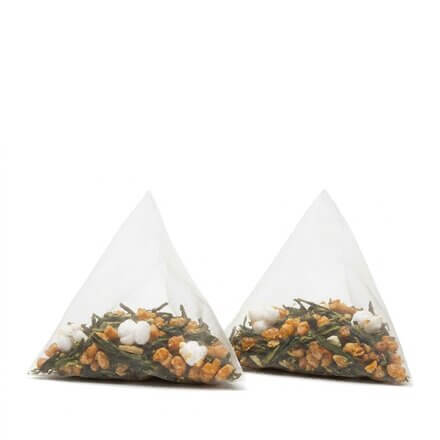
teabags
15 full leaf pyramids
$14
Fresh Portions
genmai cha
portions
Teforia-ready
$14
Lore
Puffed rice is made by applying steam and high pressure to rice kernels, similar to how popcorn is made from corn. Popular in many Asian countries, it can be served in spicy, savory, or sweet dishes and is even offered to Hindu gods or goddesses in some regions. In the US, it is more commonly found in cereals like and candy bars. Today, most puffed rice is made using the "gun puffing" method, which was developed by American inventor Alexander P. Anderson, who first showcased his invention at the World's Fair in 1904.
Questions and Answers
Ask a question about genmai cha and have the Adagio Teas community offer feedback.
Is this the same tea as the Green Popcorn tea bags?
Asked by Mactoons
on October 22nd, 2019
on October 22nd, 2019
Is this Sencha or Bancha Genmai cha? Thank you
Asked by Stephanie Rangel
on January 13th, 2021
on January 13th, 2021
Does this contain only rice and tea? Some genmai cha I have had include corn.
Asked by Christina Ek
on June 5th, 2021
on June 5th, 2021
Does Genmai Cha contain gluten? (rice is a GRAIN)
Asked by JEROLYN JANSSEN
on June 13th, 2022
on June 13th, 2022
Is it made with gyokuro
Asked by Lauren Saltman
on April 23rd, 2023
on April 23rd, 2023
Is the genmai cha tea made with toasted white or brown rice? Thanks
Asked by Sheryl Ransom
on May 19th, 2024
on May 19th, 2024
Direct Trade Advantage
We import directly from the artisan farmers whose names and faces you'll find throughout our website.
This makes our products fresher than those offered by the companies who use middlemen and brokers, and also less expensive.
Here's a comparison of how much more you'd be paying by buying this elsewhere:
David's Tea:
73% more expensive
Meet our genmai cha farmer, Masuda Yoshio
To ensure the best quality and value, we import our teas directly from the countries in which they are grown, working closely with the farmers who tender them. Our Roots Campaign connects our customers with the rich stories and the farmers behind some of our most popular teas.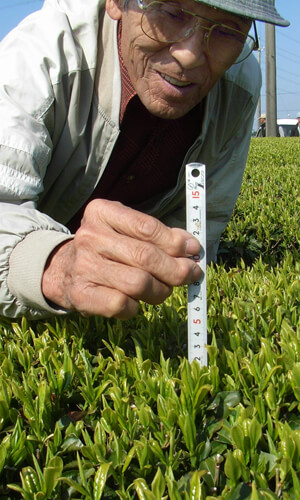
How long have you been growing tea?
“I was born and raised in Makihohara region, the Japan's No.1 green tea production area. I have been involved with green tea production for the past 38 years.”
What got you started in the Tea industry?
“My grandfather started green tea farming and production, and my father took over it and then myself. I am the third generation. Masudaen as a company has been doing green tea business for almost a century now.”
Can you describe a typical day out in the field. How many hours would that be?
“I walk around the green tea fields at 6AM every morning, and checking green tea bushes. During harvest season, I harvest tea leaves with young staff, and do the processing also. Freshness is the most crucial thing for green tea. So, our factory is moving 24 hours a day during the harvest season. The harvested tea leaves becomes green tea (finished products) the next day. ”
What Is Genmai Cha Tea?
Genmai Cha (玄米茶) is a Japanese blended tea made from green tea — typically Sencha or Bancha — combined with toasted, roasted, and puffed brown rice. The name translates directly as "brown rice tea" (玄米 = brown/unpolished rice, 茶 = tea). It is one of Japan's most widely consumed teas, appreciated for its warm, nutty, savory character and the way the toasted rice rounds and softens the green tea's natural astringency.
The puffed rice grains in Genmai Cha — which pop during the roasting process and closely resemble miniature popcorn — have earned it the informal English nickname "popcorn tea." In Japan it is sometimes called "people's tea" (おまめ茶) for its unpretentious, everyday character: accessible, warming, food-friendly, and without the refinement demands of premium single-origin green teas. It is the Japanese tea most often drunk at mealtimes.
The History of Genmai Cha: From Economy to Tradition
Genmai Cha's origin is rooted in practical necessity rather than culinary aspiration. During periods when tea was expensive or in short supply — particularly in post-war Japan — blending tea with roasted rice reduced the cost of each serving by extending the tea leaves further. Roasted rice was cheap, available, and added a pleasant warmth to the blend that compensated for the reduction in tea character.
What began as an economy measure became, over decades, one of Japan's most distinctive tea traditions. The warming, nutty, savory quality of the roasted rice proved to be a flavour combination worth keeping long after tea became affordable and abundant. Today Genmai Cha is made with full-quality green tea leaves blended with roasted brown rice — not as a compromise but as a deliberately crafted flavour experience that cannot be achieved with green tea alone.
The connection to puffed rice itself has its own history. The "gun puffing" method that produces puffed rice — applying steam and high pressure to rice kernels until they expand and pop — was developed by American inventor Alexander P. Anderson and first showcased at the 1904 World's Fair in St. Louis. Anderson's technique industrialised puffed rice production and eventually found its way into the toasted-and-puffed rice that gives Genmai Cha its characteristic popcorn-like visual appearance and contribution to the cup's aroma.
Why Genmai Cha Has Less Bitterness Than Standard Green Tea
The most practically important quality of Genmai Cha for buyers who find pure green tea too sharp: the toasted rice component actively reduces the cup's astringency through two mechanisms.
- Dilution of tea content — the rice takes up volume that would otherwise be occupied by tea leaves, meaning that per gram of blend, there is less catechin-containing tea material than in a pure green tea at the same leaf-to-water ratio. Less catechin = less bitterness and astringency.
- Flavour masking and complementing — the warm, nutty, roasted character of the toasted rice occupies the aromatic space that green tea's grassiness and sharpness would otherwise dominate. The rice doesn't eliminate the green tea character; it rounds it and provides a complementary warm dimension that makes the overall cup feel milder and more accessible.
The result is a cup that drinks more approachably than Sencha for most Western palates, while retaining the moderate caffeine and general green tea character that makes it appropriate as a daily-drinking, mealtime tea.
Genmai Cha Flavour Profile
- Warm and nutty — the dominant quality, arriving from the first sip. The toasted brown rice contributes a warm, slightly caramelised nuttiness that is immediately distinct from standard green tea. Closer in character to a light roasted barley or the aroma of a rice-based Japanese dish than to anything in the standard green tea flavour vocabulary.
- Savory quality — the product description's "lovely savory quality" is precise. Genmai Cha has a subtle umami-adjacent dimension — not as pronounced as Gyokuro's dedicated L-theanine-rich umami, but a gentle savory warmth that makes the cup feel satisfying alongside food rather than competing with it.
- Toasted rice aroma — the most immediately distinctive sensory quality of the dry leaf. Opening a pouch of Genmai Cha produces an aroma that reviewers consistently compare to rice cereal, rice cakes, and popcorn — warm, dry, toasty, immediately recognisable. One of the most pleasant dry-leaf aromas in the green tea range.
- Green tea freshness underneath — the Sencha or Bancha base contributes a clean, light, fresh green tea character that prevents the toasted rice warmth from becoming too heavy. The combination is toasty on top and fresh underneath.
- Moderate astringency — significantly gentler than pure Sencha or Bancha at the same steeping parameters. Approachable for buyers who find standard Japanese green tea too sharp or too demanding.
Genmai Cha as a Food Tea
The product description identifies Genmai Cha as "a great solution for those seeking a substantial, but less astringent flavour" — and "easy to combine with food" is the phrase that most precisely captures its primary use case. Genmai Cha is the Japanese tea most naturally suited to mealtime drinking for specific reasons:
- Warm and savory pairs with food — the toasted rice character sits in the same flavour register as cooked rice, grains, and bread — foods that form the basis of most meals. It complements rather than contrasts with a wide range of cuisines.
- Lower astringency — the reduced astringency means Genmai Cha doesn't cut through fatty or rich foods the way a sharp Sencha might. It accompanies without competing.
- Substantial body — the rice content gives the cup a slight body and warmth that feels appropriate alongside food rather than as a palate cleanser between bites.
Traditional Japanese pairings: sushi, tempura, rice dishes, light noodle soups, and the everyday Japanese meal context where green tea appears at every table as a matter of course. Western food pairings: grilled fish, lightly seasoned chicken, rice dishes, sushi rolls, and any meal where you'd naturally serve still water rather than wine.
Genmai Cha vs. Other Japanese Green Teas
Where Genmai Cha sits in Adagio's Japanese green tea collection:
- Genmai Cha (scored 94, 2,522 reviews, from 17¢/cup) — green tea with toasted rice. Warm, nutty, savory, less astringent. The food tea, the everyday tea, the entry point for anyone new to Japanese green tea. 180°F.
- Gyokuro (scored 94, 929 reviews, from 42¢/cup) — shade-grown premium Japanese green tea. Deep umami, seaweed, buttered greens, silky smooth. The ceremonial single-origin green tea. 165°F. See Gyokuro.
- Jasmine Phoenix Pearls (scored 97, 3,444 reviews, from 40¢/cup) — hand-rolled jasmine-scented green tea pearls. Sweet, perfumy, unfurling visual. The gift green tea. 195°F. See Jasmine Phoenix Pearls.
The practical guide: Genmai Cha for an accessible, warming, food-pairing everyday Japanese tea at the lowest price in the range; Gyokuro for the most sophisticated and umami-rich premium Japanese green tea experience; Jasmine Phoenix Pearls for the most visually spectacular and aromatically vivid gift.
How to Brew Genmai Cha Tea
- Water temperature — 180°F (82°C). Below boiling, like most Japanese green teas. The Sencha or Bancha green tea component requires below-boiling water to avoid bitterness; the roasted rice component is less temperature-sensitive but benefits from the same gentler extraction.
- Leaf quantity — one heaping teaspoon (2–3g) per 8oz cup. The blend's density varies between the lighter green tea leaves and the heavier rice grains; measure by weight for the most consistent results.
- Steep time — 2–3 minutes. The product panel warns "over-steeping may taste bitter" — accurate, particularly for the green tea component. Two minutes produces a lighter, more rice-forward cup; three minutes produces more green tea character. Two minutes is recommended for first exploration.
- Multiple steepings — Genmai Cha yields a good second steeping. The rice character is slightly more muted in the second steep; the green tea freshness comes forward. A different but pleasant cup from the same leaves.
- With meals — the primary recommended serving context. Genmai Cha alongside food is its natural state. Brew a pot at the start of a meal and refill through the course of eating.
- Plain — no milk, no sweetener. Genmai Cha's savory warmth is entirely its own; anything added would compete with rather than complement the toasted rice character.
Genmai Cha Tea Caffeine Content
Genmai Cha contains approximately 20–40mg of caffeine per 8oz cup — toward the lower end of the green tea range, because the toasted rice component dilutes the tea content of the blend. Per gram of dry blend, Genmai Cha contains less actual tea leaf (and therefore less caffeine) than a pure green tea of equivalent weight. This makes Genmai Cha one of the most moderate-caffeine Japanese green teas in the Adagio collection — appropriate from morning through early evening for most drinkers, and a practical choice for anyone who wants Japanese green tea character without the higher caffeine of a pure Sencha or Gyokuro.
Genmai Cha and the Teas of Japan Sampler
Genmai Cha is one of four teas in the Teas of Japan Sampler — alongside Hojicha, Kukicha, and Sencha Overture. The sampler is the most efficient introduction to the full range of Japanese green tea styles: Genmai Cha for toasted rice warmth; Hojicha for roasted depth; Kukicha for a lighter twig-tea character; Sencha for the classic full-leaf Japanese green tea. At $16 for 40 cups (four teas, ten cups each), it's the most instructive Japanese tea value in the catalog for anyone new to the category. See the Teas of Japan Sampler.
Genmai Cha Tea as a Gift
Genmai Cha is the most accessible and most universally appealing Japanese tea gift in the Adagio collection — the one that works for any recipient, regardless of their prior experience with Japanese tea. The toasted rice aroma is immediately inviting rather than challenging; the "popcorn tea" nickname gives it an instant hook; and the 2,522 reviews at 94 provide the quality evidence that makes the recommendation confident.
Available in a sample ($4, 10 cups), 4oz ($14, 50 cups, 28¢/cup), 16oz ($34, 200 cups, 17¢/cup), portions ($14), and pyramid teabags ($14, 15 bags). The 4oz pouch at $14 is the ideal gift size — accessible in price, visually distinctive with the rice-and-leaf dry leaf, and fragrant enough on opening that the gift communicates itself immediately. Pair with the Teas of Japan Sampler for a complete Japanese tea exploration that places Genmai Cha in context alongside Hojicha, Kukicha, and Sencha.
Buy Genmai Cha Tea Online
Order Genmai Cha loose leaf tea online — Japanese green tea with toasted popped brown rice (玄米茶), scored 94 by 2,522 customers, from 17¢ per cup. Free shipping on qualifying orders. Available in sample, 4oz, and 16oz loose leaf pouches, portions, and pyramid teabag format. Delivered from Adagio's New Jersey warehouse within one business day.