94
dragonwell tea
based on 1294 reviews
Your savings will grow with each shipment. Save 5% now, and up to 15% in the future. Please select size:
sample
makes 10 cups
$8
3oz
77¢ per cup
$29
16oz
45¢ per cup
$89
teabags
15 full leaf pyramids
$24
portions
Teforia-ready
$24
Dragonwell Tea (龍井, Lóngjǐng — "Dragon Well"), also known as Lung Ching or Longjing, is one of China's most famous green teas, originating from the Longjing tea gardens of Hangzhou in Zhejiang province. This tea has a very distinctive shape: smooth and perfectly flattened along the inside vein of the leaf, the result of a highly skilled shaping process performed in a hot wok — pan-firing or pan-frying, perfected by Chinese tea masters over many centuries. This process gives the tea its inviting, toasty aroma.
Our fine Dragonwell green tea has a sweet, rounded flavour, perhaps reminiscent of freshly roasted white corn — full, nutty and buttery texture, with a pleasantly dry finish. A truly satisfying cup, backed by one of the most celebrated origin stories in Chinese tea culture: according to legend, the Qianlong Emperor once visited the Longjing gardens and began picking leaves himself, before being called away suddenly when his mother fell ill. He stuffed the leaves into his sleeve as he left — and the tea has been shaped flat, like those imperial sleeve-stored leaves, ever since.
Our fine Dragonwell green tea has a sweet, rounded flavour, perhaps reminiscent of freshly roasted white corn — full, nutty and buttery texture, with a pleasantly dry finish. A truly satisfying cup, backed by one of the most celebrated origin stories in Chinese tea culture: according to legend, the Qianlong Emperor once visited the Longjing gardens and began picking leaves himself, before being called away suddenly when his mother fell ill. He stuffed the leaves into his sleeve as he left — and the tea has been shaped flat, like those imperial sleeve-stored leaves, ever since.

TEA TYPE
Green Tea

CAFFEINE
Moderate
Green tea usually offers a gentler lift than black tea or coffee, with enough caffeine for a light, refreshing boost.

STEEP
180° for 2-3 mins
Use the shorter steep for a smoother cup; over-steeping may taste bitter.
Customer Reviews (1294)
Teabags
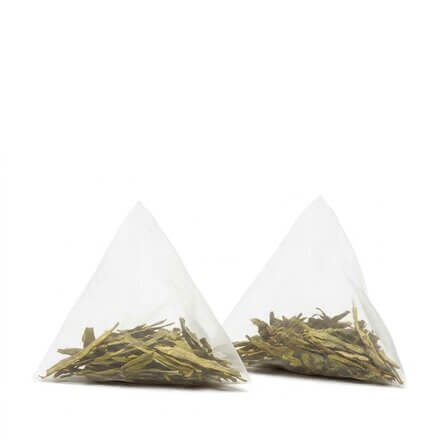
teabags
15 full leaf pyramids
$24
Fresh Portions
dragonwell
portions
Teforia-ready
$24
Lore
Dragonwell, or Longjing, tea is known for its long flat shape. This is caused by the wok-frying process used to stop oxidization; however, there are rumors as to other ways the tea could have gotten its shape. One legend states that while visiting the Longjing tea gardens, the Qianlong Emperor was so impressed that he wanted to try picking the leaves himself. However, he was called away during picking when he found out his mother was ill. Rumor says the leaves have been shaped to look like the ones he stored in his sleeve as he left ever since.
Treat Yourself to a Higher Grade
Savor the exquisite aroma and rich flavor of our zhejiang lung ching tea.
sample
makes 10 cups
$12
2.5oz
157¢ per cup
$49
Questions and Answers
Ask a question about dragonwell and have the Adagio Teas community offer feedback.
HOW TO BREW DRAGON WELL TEA?
Asked by RONALD SCHWARTZ
on January 30th, 2018
on January 30th, 2018
When reading the interview with the farmer Yao Fu Yun he stated that the water temperature is better around 85-90 degrees. Does he mean Fahrenheit or Celsius?
Asked by Jessica Laxo
on December 22nd, 2020
on December 22nd, 2020
Meet our dragonwell farmer, Yao Fu Yun
To ensure the best quality and value, we import our teas directly from the countries in which they are grown, working closely with the farmers who tender them. Our Roots Campaign connects our customers with the rich stories and the farmers behind some of our most popular teas.
How long have you been growing tea?
“More than 30 years.”
What got you started in the Tea industry?
“Hangzhou is a beautiful place with mountain and water, which is a suitable for tea growing. I love the place and I love tea. So I work for tea. Our tea garden is a state-owned when I began to work 30 years ago.”
Can you describe a typical day out in the field. How many hours would that be?
“I go to the tea garden at 7 am every morning. First I will do some weeding and loosing the soil. I stop at about 11 am. The weeds can be easily withered and cannot be survival after weeding. Then I will have lunch and take a nap for one hour. In the afternoon I will check the tools to see if needing repairing. And then I will do some fertilization and pruning. Pruning can make the tea leaves to grow up easily. Besides, it can help us to pick up tea leaves easily as well. The above is what I do during leisure time. Normally I will work in the tea garden for 9-10 hours a day. If the tea season is coming, I will be very busy to make teas the whole day. I must finish making the tea leaves picked at the same day, no matter how late is. Otherise the tea leaves are useless and waste.”
What Is Dragonwell Tea?
Dragonwell Tea (龍井茶, Lóngjǐng Chá) — also called Longjing, Lung Ching, and in some markets Dragon Well — is one of China's ten most famous teas and the most celebrated pan-fired green tea in the world. It originates from the Longjing tea gardens in the West Lake (西湖, Xī Hú) district of Hangzhou, Zhejiang province — one of the most historically and culturally significant tea-growing regions in China, designated a UNESCO World Cultural Heritage site in 2011.
The name "Longjing" (龍井) translates as "Dragon Well" — a reference to a well in the Longjing village area that, according to local legend, is connected to an underground dragon. Heavy rains would cause the well to produce a swirling pattern in the water resembling a dragon's movement, which gave the village and eventually the tea its name. The Western name "Dragonwell" is a direct translation of the same legend.
The Qianlong Emperor Legend: Why Dragonwell Tea Is Flat
The flat, sword-like shape of Dragonwell leaves is the tea's most immediately distinctive visual characteristic — and the origin of that shape has one of the most charming legends in all of Chinese tea culture:
During the Qing Dynasty, the Qianlong Emperor (乾隆皇帝, reigned 1735–1796) was known for his extensive travels throughout China and his deep interest in the arts, culture, and natural products of his empire. According to legend, he visited the Longjing tea gardens near Hangzhou and was so impressed by what he found that he wanted to try tea picking himself. He began plucking leaves from the bushes.
Before he could finish, a courier arrived with urgent news: his mother, the Empress Dowager, had fallen seriously ill. The Emperor had to leave immediately. In his haste, he gathered the tea leaves he had picked and stuffed them into his sleeve as he departed.
When the Emperor reached his mother's side, the warmth of his body had been pressing against the leaves in his sleeve throughout the journey, gently flattening them into the smooth, flat shape that distinguished them. According to the legend, the tea masters at Longjing — either in honour of the imperial visit or in response to the Emperor's own unintentional innovation — began shaping Longjing leaves flat to resemble those he had carried. The distinctive pressed, flat shape of Dragonwell tea has persisted ever since.
The legend is almost certainly apocryphal — the flat leaf shape of Longjing predates the Qianlong Emperor's reign by centuries, and the actual flat shape results from the specific hand-pressing technique in the hot wok during pan-firing. But the Qianlong Emperor did famously visit Hangzhou and did officially designate eighteen specific tea bushes at the Longjing gardens as imperial tribute tea — bushes that still exist and are still harvested today, producing tea sold at prices that make even Adagio's premium Zhejiang Lung Ching look modest by comparison.
The Pan-Firing Process: Why Dragonwell Tastes Different from Japanese Green Tea
Dragonwell is the most prominent example of pan-fired Chinese green tea — and the pan-firing process is the single most important reason it tastes fundamentally different from Japanese Sencha, Gyokuro, or Matcha:
- Pan-firing (炒青, chǎo qīng) — Dragonwell leaves are tossed and pressed by hand in a very hot, dry iron wok during processing. The high heat halts oxidation and simultaneously imparts the characteristic toasty, slightly nutty aroma and flavour that defines Dragonwell. The pressing in the wok is also what produces the flat, sword-like leaf shape.
- Steaming (蒸青, zhēng qīng) — Japanese green teas (Sencha, Gyokuro, Matcha) halt oxidation through steam rather than dry heat. Steaming preserves more of the fresh, grassy, marine-umami character of the tea. Pan-firing converts more of those fresh compounds into the toasty, nutty, roasted character that defines Dragonwell.
The result: Dragonwell is warmer, nuttier, and more toasty than Japanese green teas. Japanese Sencha is greener, more vegetal, and more oceanic. Both are excellent — they are the two great pan-fired and steamed green tea traditions, expressing the same plant through opposite processing approaches.
Dragonwell Tea Flavour Profile
- Freshly roasted white corn — the product description's most specific and most accurate flavour analogy. The combination of pan-firing's gentle toasting and Dragonwell's particular cultivar produces a sweet, warm, starchy-nutty character that reviewers consistently verify: not generic nuttiness, but specifically roasted corn, dry and slightly sweet.
- Toasty and inviting aroma — the defining aromatic quality from the moment the pouch opens. The hot wok pan-firing imparts a warm, toasted aroma that is immediately different from the fresh, grassy aromas of steamed Japanese green teas. Warmer, rounder, more food-adjacent.
- Full, nutty character — the overall flavour register. Alongside the roasted corn note, a broader nuttiness — chestnut-adjacent, warm, dry — that gives Dragonwell its distinctive "full" quality.
- Buttery texture — a smooth, coating mouthfeel that reviewers consistently note as one of Dragonwell's most appealing qualities. The pan-firing process produces natural compounds that contribute this buttery texture without any actual butter or dairy content.
- Pleasantly dry finish — a slightly drying, clean close that prevents the cup from feeling heavy despite its buttery warmth. The dry finish is what makes Dragonwell so food-compatible — the light astringency at the close clears the palate.
- Pale yellow-green liquor — the visual quality indicator reviewers consistently note. Clear, warm, golden-green — distinctly different from the vivid jade green of Japanese Sencha, reflecting the pan-fired processing rather than steaming.
Dragonwell vs. Adagio's Japanese Green Teas
The most useful comparison for buyers exploring Chinese vs Japanese green tea:
- Dragonwell Tea (scored 94, 1,294 reviews, from 45¢/cup) — Chinese, pan-fired, Hangzhou/Zhejiang. Toasty, roasted white corn, nutty, buttery. Warm, food-compatible, dry finish. Pale yellow-green liquor. 180°F, 2–3 minutes.
- Sencha Premier (scored 94, 848 reviews, from 30¢/cup) — Japanese, steamed, Shizuoka. Edamame, fresh grass, sweet umami. Delicate, paler jade liquor. 165°F, 2 minutes. See Sencha Premier.
- Gyokuro (scored 94, 929 reviews, from 42¢/cup) — Japanese, shade-grown, steamed. Deep umami, seaweed, buttered greens. Japan's most prestigious loose leaf green. 165°F, 2–3 minutes. See Gyokuro.
The practical distinction: pan-fired Chinese green teas (Dragonwell, Gunpowder) taste warmer, nuttier, and more toasty; steamed Japanese green teas (Sencha, Gyokuro) taste greener, more vegetal, and more umami-rich. Both traditions produce exceptional tea — they are genuinely different approaches rather than one being better. Dragonwell is the right choice for buyers who find Japanese green tea too grassy or too oceanic; Japanese Sencha is the right choice for buyers who find Dragonwell too nutty or too roasty.
How to Brew Dragonwell Tea
- Water temperature — 180°F (82°C). The same below-boiling temperature as Gunpowder and Jasmine Chun Hao, and somewhat higher than the most delicate Japanese green teas. Pan-fired green teas can tolerate slightly higher temperatures than steamed green teas without producing bitterness — 180°F is the sweet spot for Dragonwell.
- Leaf quantity — one teaspoon (2–3g) per 8oz cup. The flat, open leaf style looks like more than it weighs; standard measurement produces reliable results.
- Steep time — 2–3 minutes. The product panel warns "over-steeping may taste bitter." Two minutes produces the most delicate, aromatic cup where the toasty notes are most vivid; three minutes develops slightly more body and the dry finish becomes more prominent.
- Multiple steepings — Dragonwell yields 2–3 quality steepings. The roasted corn and toasty aroma is most vivid in the first steep; the second steep shows more of the clean, buttery base character; the third is lighter and more delicately nutty.
- Glass vessel — recommended to appreciate the flat leaf unfurling in the water. Dragonwell's distinctive flat leaves open differently from rolled or twisted teas — they lie flat in the water rather than unfurling from a compact form, producing an elegant visual effect in a clear vessel.
- Plain — no milk, no sweetener. The roasted corn sweetness and buttery texture are entirely the tea's own character; anything added competes with rather than complements the dry, clean finish.
The Higher Grade: Zhejiang Lung Ching
Adagio carries a second Dragonwell-style tea — Zhejiang Lung Ching — at a higher grade and price point (157¢/cup for the 2.5oz pouch vs 45¢/cup for Dragonwell's 16oz). For buyers who want to explore the premium expression of this tradition, Zhejiang Lung Ching represents the step up: more meticulously selected leaf material, more pronounced aromatic character, and the more elevated price that authentic premium Longjing commands.
Dragonwell Tea Caffeine Content
Dragonwell Tea contains approximately 25–45mg of caffeine per 8oz cup — the standard moderate green tea range. The 180°F, 2–3 minute brewing parameters produce moderate caffeine extraction. Pan-fired green teas tend toward slightly lower caffeine than steamed green teas of equivalent grade, because the pan-firing process can degrade some caffeine compounds. L-theanine is present and meaningful in Dragonwell's spring-harvested material. A morning-through-afternoon tea suitable for multiple cups without caffeine accumulation concern.
Dragonwell Tea as a Gift
Dragonwell Tea is the most culturally storied Chinese green tea gift in the Adagio collection — the one with the Qianlong Emperor origin legend, the UNESCO-recognised West Lake origin, and the 30-year farming heritage of Yao Fu Yun behind it. For any recipient who appreciates Chinese culture or history, the combination of the emperor's sleeve story and the distinctive flat-leaf visual makes Dragonwell the most memorable tea gift in the Chinese green tea range.
Available in a sample ($8, 10 cups), 3oz ($29, 37 cups, 77¢/cup), 16oz ($89, 197 cups, 45¢/cup), portions ($24), and pyramid teabags ($24, 15 bags). The 3oz pouch is the right gift size for an introduction. Pair with Gunpowder Tea for the most instructive Chinese pan-fired green tea comparison — both are Zhejiang province pan-fired greens expressing completely different character through different rolling and firing approaches.
Buy Dragonwell Tea Online
Order Dragonwell loose leaf tea online — Longjing pan-fired green tea from Hangzhou, Zhejiang province, China (龍井茶), scored 94 by 1,294 customers, from 45¢ per cup. Free shipping on qualifying orders. Available in sample, 3oz, and 16oz loose leaf pouches, portions, and pyramid teabag format. Delivered from Adagio's New Jersey warehouse within one business day.