90
lapsang souchong tea
based on 2104 reviews
Your savings will grow with each shipment. Save 5% now, and up to 15% in the future. Please select size:
sample
makes 10 cups
$4
3oz
27¢ per cup
$10
16oz
20¢ per cup
$39
teabags
15 full leaf pyramids
$10
Lapsang Souchong is a black tea from the Fujian province of China, famous for its smoky aroma and flavor, produced in the Wuyi Mountain region that also gives the world its most celebrated rock oolongs. To create the smoke, the finished tea is given extra drying over a burning pine fire — the pine smoke penetrates the leaf and imparts a sweet, clean smokiness that is fundamentally different from the harsh, acrid character that badly smoked Lapsang produces.
Lapsang Souchong sometimes gets a bad reputation for being brashly smoky, but really fine examples aren't like that at all. Our Lapsang Souchong is very approachable: clean and slightly cool smokiness in the aroma, like menthol. Sweet, refreshing smoky flavor, crisp and edgy. A golden-coppery color in the cup — the mark of a Lapsang that hasn't been smoked to a jerky. Sweet pine flavor, lightly savory, with a clean finish that invites the next sip rather than demanding a glass of water.
Lapsang Souchong sometimes gets a bad reputation for being brashly smoky, but really fine examples aren't like that at all. Our Lapsang Souchong is very approachable: clean and slightly cool smokiness in the aroma, like menthol. Sweet, refreshing smoky flavor, crisp and edgy. A golden-coppery color in the cup — the mark of a Lapsang that hasn't been smoked to a jerky. Sweet pine flavor, lightly savory, with a clean finish that invites the next sip rather than demanding a glass of water.

TEA TYPE
Black Tea

CAFFEINE
High
As a black tea, this has a fuller caffeine level, making it a good choice for morning or early afternoon. It is typically lower in caffeine than coffee.

STEEP
212° for 3-5 mins
Steep longer for a bolder cup, especially if adding milk.
Customer Reviews (2104)
Teabags
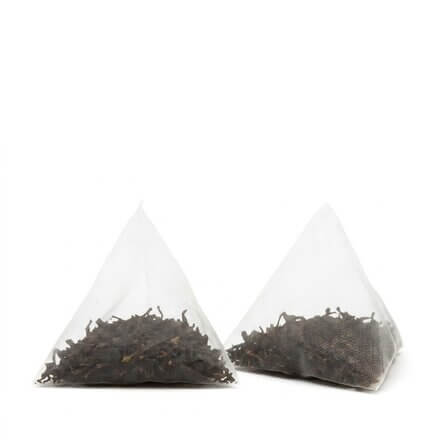
teabags
15 full leaf pyramids
$10
Lore
Famously soft-spoken American painter Bob Ross is famous for his quote, "We don't make mistakes, just happy little accidents." And throughout the history of the world, this has proven to be the case. Penicillin, the world's first antibiotic, is one example. Post-its are another. But did you know that Lapsang Souchong, perhaps the world's oldest black tea, was also created by mistake? While there are several competing theories as to its creation, most involving soldiers, bandits, and a major production backup, one thing we're sure of, we're glad it happened.
Questions and Answers
Ask a question about lapsang souchong and have the Adagio Teas community offer feedback.
Does lapsang go well with a splash of milk?
Asked by Deborah Slobodnik
on November 24th, 2017
on November 24th, 2017
Do you sell refillable/reuseable tea bags?
Asked by Betty Garrison
on April 26th, 2020
on April 26th, 2020
Does this have any artificial flavors?
Asked by TeaSnob Snob
on September 12th, 2022
on September 12th, 2022
What is the largest bag of lapsang souchong loose tea I can buy?
Asked by Anne Mai
on February 27th, 2025
on February 27th, 2025
how many cups of tea in a sample?
Asked by
on May 18th, 2026
on May 18th, 2026
Direct Trade Advantage
We import directly from the artisan farmers whose names and faces you'll find throughout our website.
This makes our products fresher than those offered by the companies who use middlemen and brokers, and also less expensive.
Here's a comparison of how much more you'd be paying by buying this elsewhere:
David's Tea:
51% more expensive
Meet our lapsang souchong farmer, Fang Ai Hua
To ensure the best quality and value, we import our teas directly from the countries in which they are grown, working closely with the farmers who tender them. Our Roots Campaign connects our customers with the rich stories and the farmers behind some of our most popular teas.
How long have you been growing tea and what got you started?
“In my hometown everyone is dealing with tea. So I started when I was 18 years old. I learned from my parents. Now I know how to pick tea leaves and make good lapsang.”
Can you describe a typical day out in the field?
“My hometown is very beautiful mountian area. This area is protected by government. I am so lucky to live in the natural protection area in Wuyi.”
What is your favorite part of growing tea?
“I like the moment when we taste our teas made by ourselves. We will taste every lot after production. I am happy to drink the tea from my own hand.”
What Is Lapsang Souchong Tea?
Lapsang Souchong (正山小種, Zhèngshān Xiǎozhǒng) is a black tea from the Wuyi Mountain region of Fujian province in southeastern China — the same mountainous area that produces Wuyi rock oolongs, one of the most celebrated tea regions in the world. The "Souchong" refers to the fourth and fifth leaves from the top of the tea plant — slightly lower and larger than the tender tips used for premium grades — traditionally used for Lapsang production.
What makes Lapsang Souchong uniquely itself is the smoking process: after the leaves are processed into black tea, they are dried over a burning pinewood fire — the pine smoke penetrating and bonding to the leaf material, imparting the characteristic smoky character that no other tea origin or processing method replicates. The specific pine used is typically local Fujian mountain pine (Pinus massoniana), whose resinous, slightly sweet smoke is the specific smoke character that defines authentic Lapsang Souchong.
The Reputation Problem: Why Lapsang Souchong Gets Misunderstood
Lapsang Souchong is the most polarising tea in the Adagio catalog — and the polarisation exists for a specific reason: there is a significant quality range within the Lapsang Souchong category, and badly produced Lapsang is genuinely unpleasant in a way that most bad tea isn't.
Over-smoked Lapsang — which describes a substantial portion of commercially available Lapsang Souchong — tastes like an ashtray, dried meat, or campfire ash. The smoke has been applied so aggressively that it overwhelms the tea's own character, leaving nothing in the cup except smoke. This is the Lapsang that gives the category its reputation for being "an acquired taste" — and it's the wrong way to produce it.
Well-produced Lapsang Souchong — like Adagio's — uses a measured pine smoking process that imparts sweet, clean smoke rather than aggressive, acrid smoke. The golden-coppery liquor color (as opposed to the very dark, almost opaque color of over-smoked Lapsang) is the visual indicator that the smoking was controlled. The slightly cool, menthol quality in the aroma is the olfactory indicator. A clean, sweet pine flavor in the cup — rather than ash and bitterness — is the taste indicator.
Adagio's Lapsang Souchong scored 90 from 2,104 customers. In a category where the baseline expectation is that the tea is either loved or hated, 90 is the score that says: this one converts people who thought they didn't like Lapsang.
Lapsang Souchong Flavor Profile
- Sweet, clean smokiness — the dominant character, present from the first moment the hot water contacts the leaf. Not acrid, not harsh — sweet and clean, closer to campfire embers or woodsmoke on a cold morning than to cigarette smoke or overcooked meat.
- Slightly cool and menthol in the aroma — one of the most unusual and specific qualities of well-produced Lapsang. The pine smoke imparts a faint, cooling aromatic quality that reads almost like menthol in the nose — quite different from what "smoky tea" typically suggests.
- Sweet pine flavor — the specific character of pine smoke rather than generic wood smoke. Lapsang Souchong from Fujian made with local mountain pine has a distinctly sweeter smoke character than versions made with other wood types.
- Golden-coppery liquor — the visual quality indicator described in the product description. A Lapsang brewed to this color has been smoked correctly; a Lapsang that brews very dark has typically been over-smoked.
- Lightly savory, clean finish — the finish is clean and slightly savory rather than bitter or astringent. The savory quality is a natural consequence of the smoking process and is part of what makes Lapsang suitable as a food-pairing tea.
What Does Lapsang Souchong Taste Like? An Honest Guide
This is the most-searched question about Lapsang Souchong and the one that most product pages fail to answer honestly. Here is the honest answer:
If you like: campfire smells, wood-smoked meats, smoky whisky (Scotch), smoked salmon, pine forests, or the smell of a wood fire — you will almost certainly enjoy well-produced Lapsang Souchong. The flavor occupies a similar register to all of these: sweet, clean smoke with a resinous pine character and a savory undercurrent.
If you dislike: any smoke character in food or drink, strongly flavoured tea, or the idea of a tea that tastes like something other than tea — Lapsang Souchong is not likely to be for you, regardless of quality. This is one category where the fundamental character is either appealing or not, and no amount of sourcing quality changes the fundamental nature of pine-smoked tea.
If you're curious but uncertain: try the sample size ($4, 10 cups) before committing to a larger pouch. The sample is specifically the right format for Lapsang — it costs very little to discover whether you're in the "love it" or "not for me" camp, and the discovery is worth making.
Lapsang Souchong and Food Pairing
Lapsang Souchong has a more developed food pairing culture than any other tea — because its smoky, savory character interacts with food in ways that other teas don't. Several pairings that consistently work:
- Smoked salmon — the most natural pairing. Lapsang and smoked salmon share a common flavor register; drinking Lapsang alongside smoked salmon is less a contrast than a doubling of the same character. They amplify each other rather than competing.
- Aged and sharp cheeses — Manchego, aged cheddar, and other sharp, slightly savory cheeses provide a counterpoint to the sweet smoke. The fat in the cheese softens the tannins; the smoke in the tea cuts through the fat.
- Dark chocolate — the bitterness and roasted character of dark chocolate complements Lapsang's sweet smokiness in a combination that most people find unexpectedly harmonious.
- Smoked or barbecued meats — Lapsang as a table drink alongside smoked meats creates a coherent smoke-and-protein experience that works particularly well at outdoor settings where the fire smell is already present.
- Lapsang in cooking — Lapsang Souchong can be used as a cooking ingredient: as a liquid smoke substitute in marinades, as a tea-smoked meat preparation base, or brewed and reduced as a smoky tea sauce. The flavor survives heat well enough to remain identifiable in cooked applications.
Lapsang Souchong in Cocktails
Lapsang Souchong has a genuine and growing presence in cocktail culture — the smoky character that can be challenging in a tea context translates very naturally into spirit-based drinks where smoke is already an appreciated quality:
- Lapsang-infused whisky — steep Lapsang Souchong in Scotch whisky (particularly an already-smoky Islay malt) for 2–4 hours to intensify the smoke character and add the pine-sweet dimension of the tea.
- Lapsang Simple Syrup — brew Lapsang at double strength, add equal weight of sugar, heat gently to dissolve. The resulting syrup carries the sweet pine smoke into cocktails, mocktails, and even coffee drinks.
- Cold brew Lapsang for cocktails — cold brewed Lapsang Souchong produces a less aggressively smoky concentrate that mixes more smoothly into cocktails than hot-brewed Lapsang. Combine with bourbon, honey, and lemon for a smoky whisky sour variant.
How to Brew Lapsang Souchong Tea
- Water temperature — 212°F (100°C), fully boiling.
- Leaf quantity — one teaspoon (2–3g) per 8oz cup. Lapsang is one of the few teas where using slightly less leaf than usual — 1.5g rather than 2–3g — is worth considering for a first brew, to find the smoke intensity level you prefer before committing to the full measure.
- Steep time — 3–5 minutes. Three minutes produces a lighter, more subtle smoke character; five minutes produces a fuller, more assertive smoke. Unlike most black teas, Lapsang's smoke character doesn't develop bitterness with longer steeping — it simply becomes smokier. This makes it one of the most forgiving teas to brew, which is practical in a category where the smoke intensity preference varies significantly between drinkers.
- Plain — recommended for first exploration. Adding milk reduces the smoke character; whether that's desirable depends on personal preference. Milk is a valid choice for anyone who wants the Lapsang character more restrained.
- With milk — a small amount of whole milk softens the smoke and produces something closer to a lightly smoked milk tea. Lapsang with milk and no sweetener is one of the most unusual and satisfying cold-morning drinks in the catalog.
- Cold brew — 2 teaspoons per 8oz cold water, refrigerated 8–12 hours. Cold-brewed Lapsang produces a smoother, less aggressively smoky concentrate with a sweeter, more pine-forward character than the hot version — an excellent base for cocktails and a surprisingly pleasant iced tea.
Lapsang Souchong Tea Caffeine Content
Lapsang Souchong contains approximately 40–70mg of caffeine per 8oz cup — the standard black tea range. The smoking process does not significantly affect caffeine content; caffeine comes from the black tea base and is largely unaffected by the pine drying step. Lapsang Souchong is a fully caffeinated black tea appropriate for morning and early afternoon consumption.
Lapsang Souchong as a Gift
Lapsang Souchong is the most character-specific tea gift in the Adagio catalog — the right gift for a very specific recipient and entirely wrong for everyone else. The right recipient: anyone who loves smoky whisky, smoked foods, wood fires, or who has specifically mentioned wanting to try Lapsang. The wrong recipient: anyone for whom smoke in any context is unappealing.
When it's the right gift, it's one of the most memorable in the catalog — because Lapsang Souchong is one of those things that, when you encounter it for the first time and it's right for you, you remember. The sample size ($4, 10 cups) is the ideal gift format for anyone who has expressed curiosity but hasn't tried it — the right amount to discover whether it's for them without the commitment of a full pouch. For confirmed Lapsang enthusiasts, the 16oz pouch at $39 (20¢/cup) is exceptional value for the most distinctive tea in the black tea catalog.
Buy Lapsang Souchong Tea Online
Order Lapsang Souchong loose leaf tea online — pine-dried black tea from Fujian province, China, with clean sweet smokiness, scored 90 by 2,104 customers, from 20¢ per cup. Free shipping on qualifying orders. Available in sample, 3oz, and 16oz loose leaf pouches and pyramid teabag format. Delivered from Adagio's New Jersey warehouse within one business day.