93
hojicha tea
based on 1330 reviews
Your savings will grow with each shipment. Save 5% now, and up to 15% in the future. Please select size:
sample
makes 5 cups
$3
1.5oz
48¢ per cup
$9
8oz
19¢ per cup
$19
teabags
15 full leaf pyramids
$9
Hojicha (焙じ茶, "roasted tea") is a Japanese green tea rendered a distinctive reddish-brown by roasting Bancha leaves — the summer crop harvested after Sencha — over charcoal or in a porcelain pot at high temperature. The roasting transforms the leaf completely: the vivid green colour becomes deep reddish-brown, the grassy vegetal character of the original green tea converts into toasty, nutty warmth, and much of the caffeine evaporates during the high-heat process.
The result is toasty, nutty flavour with a slightly mesquite note — earthy and warm, soothing, clean finish. No bitterness, no astringency, no grassiness. An Adagio customer favourite that reviewers describe as "comforting, relaxing, and great as an everyday staple." Because of its low caffeine content, Hojicha is traditionally used in Japan as a nighttime tea and is routinely served to children and the elderly. It is the Japanese tea you can drink at any hour.
The result is toasty, nutty flavour with a slightly mesquite note — earthy and warm, soothing, clean finish. No bitterness, no astringency, no grassiness. An Adagio customer favourite that reviewers describe as "comforting, relaxing, and great as an everyday staple." Because of its low caffeine content, Hojicha is traditionally used in Japan as a nighttime tea and is routinely served to children and the elderly. It is the Japanese tea you can drink at any hour.

TEA TYPE
Green Tea

CAFFEINE
Moderate
Green tea usually offers a gentler lift than black tea or coffee, with enough caffeine for a light, refreshing boost.

STEEP
180° for 2-3 mins
Use the shorter steep for a smoother cup; over-steeping may taste bitter.
Customer Reviews (1330)
Teabags
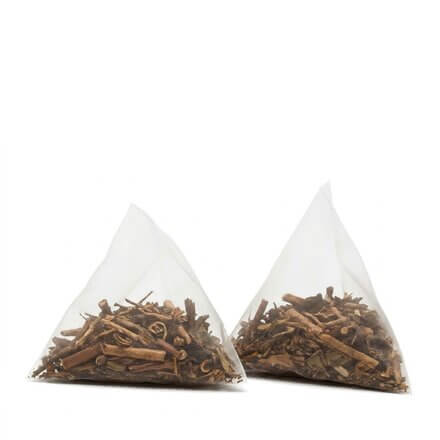
teabags
15 full leaf pyramids
$9
Lore
There are many ways to categorize tea. The most common is by color, such as white, green, or black. Tea grading categorizes tea by quality (determined by leaf wholeness and content). In Japan, teas can also be categorized by the way they are processed, such as steamed Sencha or ground Matcha. Hojicha, which is made from Bancha tea (second flush Sencha), is unique because it is roasted. During roasting, the tea leaves change color and flavor and lose some of their caffeine. For this reason, Hojicha is often used as a nighttime tea or for children and the elderly.
Questions and Answers
Ask a question about hojicha and have the Adagio Teas community offer feedback.
For someone who hates black teas, would this be a good morning tea?
Asked by Katrina Quoka
on May 8th, 2020
on May 8th, 2020
I've only ever had Hojica made in a similar way to Matcha, resulting in a latte type beverage. is it possible to grind this as a powder to use like that, or is it better to just steep regularly, then add some foamed milk?
Asked by Thea Clair
on April 27th, 2022
on April 27th, 2022
What Is Hojicha Tea?
Hojicha (焙じ茶) is a Japanese green tea that has been roasted at high temperature — typically over charcoal, in a special roasting pan, or in a porcelain cylinder — until the leaf changes from green to a deep reddish-brown. The name comes from the Japanese verb hōjiru (焙じる — "to roast") combined with cha (茶 — "tea"): "roasted tea." It is made from Bancha (番茶) — the summer flush tea harvested after the first and second Sencha flushes, when the leaves are more mature, slightly coarser, and lower in both price and caffeine than the prized early spring material.
Among Japan's major green tea styles — Sencha, Gyokuro, Matcha, Genmaicha, Kukicha, and Hojicha — Hojicha is the only one defined primarily by a post-processing roasting step. Every other Japanese tea style is defined by shading approach, harvest timing, or processing of the fresh leaf. Hojicha takes finished Bancha and transforms it again through fire.
Why Roasting Removes Caffeine: The Science Behind the Night Tea
The Lore section makes an important practical claim: "During roasting, the tea leaves change color and flavor and lose some of their caffeine. For this reason, Hojicha is often used as a nighttime tea or for children and the elderly." Both the claim and the reason behind it are accurate:
Caffeine has a relatively low sublimation temperature — approximately 178°C (352°F). When tea leaves are roasted at the high temperatures used in Hojicha production (typically 200°C/390°F or above), a meaningful proportion of the caffeine in the leaf sublimes (converts directly from solid to vapour) and is lost to the air rather than remaining in the leaf. The exact amount varies with roasting temperature and duration, but a typical Hojicha contains roughly 7–20mg of caffeine per 8oz cup compared to 25–60mg for Sencha or Gyokuro.
This makes Hojicha the lowest-caffeine true tea in the Adagio Japanese collection — lower even than Kukicha's 10–30mg range at the upper end, and dramatically lower than Sencha Premier or Gyokuro. Japanese parents routinely serve Hojicha to young children as a hot beverage option that carries no meaningful caffeine load, and elderly drinkers who need to manage stimulant intake can enjoy it late into the evening without sleep disruption. For Western buyers managing caffeine, Hojicha fills a gap that no other genuine Japanese green tea occupies: the tea you can drink after dinner.
The Roasting Transformation: Green to Brown
The visual transformation of Hojicha is as complete as its flavour transformation. Bancha before roasting looks like any other Japanese green tea — dark green, flat or twisted needles with a characteristic grassy aroma. After roasting, it looks almost nothing like green tea at all: reddish-brown, slightly curled and contracted, with a deep, warm, woody aroma that immediately communicates that something fundamentally different has been done to the leaf.
The browning is not oxidation (which is what creates black tea's dark colour) — it is the Maillard reaction and caramelisation of the leaf's natural sugars under high dry heat. The same biochemical process that browns bread, creates the crust on roasted meat, and darkens coffee beans during roasting produces Hojicha's reddish-brown colour and its characteristic toasty, nutty, slightly caramelised aroma. Hojicha and coffee share more chemistry than either shares with standard green tea.
The colour of the brewed liquor continues the transformation: where green tea brews pale jade or golden-green, Hojicha brews a warm amber-to-reddish-brown — the darkest liquor of any tea in the Japanese green tea collection. Reviewers consistently note the "unusually dark liquor for a green tea" as one of Hojicha's most immediately striking qualities.
Hojicha Flavour Profile
- Roasted nuts — the dominant quality. Warm, slightly dry, caramelised nuttiness — closer to the aroma of roasting chestnuts or lightly toasted almonds than to the fresh, grassy qualities of unroasted green tea. The most immediately distinctive quality for buyers encountering Hojicha for the first time.
- Mesquite wood note — the product description's most specific descriptor. A slightly smoky, woody quality that sits beneath the nut character — not the assertive smoke of Lapsang Souchong, but a dry, clean, wood-smoke warmth. Reviewers confirm this note: "mesquite wood" appears consistently across the review community as the most precise description of Hojicha's background character.
- Dry hay and toasted grain — reviewers compare the overall aroma to toasted wheat, rice, or dry hay — all registers of the warm, slightly starchy, golden-brown quality produced when natural plant material is heated to the point of Maillard reaction. Genmai Cha sits in the same neighbourhood; Hojicha is deeper and more purely roasted.
- Naturally sweet — despite the absence of added sugar and the absence of the fresh sweetness of unroasted leaf material, Hojicha has a warm, caramelised sweetness that reviewers consistently note. The high-temperature roasting converts some of the leaf's starches into simpler sugars, producing a sweetness that reads as toasty warmth rather than fresh fruit sweetness.
- No bitterness, no astringency — the roasting process degrades catechins (the polyphenols responsible for bitterness and astringency in unroasted tea), producing a cup that is smooth, round, and entirely non-bitter even when over-brewed. This is the quality that makes Hojicha uniquely accessible — it is genuinely difficult to make a bad cup.
- Deep amber-red liquor — the visual identity. Reviewers consistently note the colour as a surprise for a "green tea" and a source of continued pleasure. A glass vessel shows the warm, amber-to-mahogany colour at its best.
Bancha: What Hojicha Is Made From
Hojicha is made from Bancha (番茶) — a specific designation in Japanese tea grading that covers several categories of tea harvested after the premium spring and summer flushes. The name Bancha (番 = common/ordinary, 茶 = tea) reflects its positioning as Japan's everyday, accessible tea — less refined than first or second flush Sencha, more affordable, and serving a different purpose.
The Bancha used in Hojicha production is typically the late summer or autumn harvest — mature leaves and stems that have developed more fibrous structure, lower amino acid content, and less of the delicate flavour compounds that make spring Sencha prized. These qualities that make Bancha "ordinary" in its unroasted form become irrelevant after roasting: the high heat treatment replaces the leaf's original character almost entirely with the products of Maillard reaction and caramelisation. The starting material's quality matters less for Hojicha than for any other Japanese tea style, because the roasting transforms whatever it receives.
Hojicha vs. Adagio's Japanese Green Tea Collection
- Hojicha (scored 93, 1,330 reviews, from 19¢/cup) — roasted Bancha, lowest caffeine (7–20mg), no bitterness, toasty-nutty-mesquite. The night tea, the children's tea, the any-hour tea. Most accessible in flavour and price. 180°F, 2–3 minutes.
- Genmai Cha (scored 94, 2,522 reviews, from 17¢/cup) — green tea with toasted rice, low astringency, warm and nutty. Also toasty but fresher than Hojicha. The food tea. See Genmai Cha.
- Kukicha (scored 93, 1,042 reviews, from 20¢/cup) — stems and leaves, low caffeine, sesame and chestnut notes. Also low-caffeine but greener in character. See Kukicha.
- Gyokuro (scored 94, 929 reviews, from 42¢/cup) — shade-grown, highest caffeine, deep umami. The opposite end of the Japanese green tea spectrum from Hojicha. See Gyokuro.
Hojicha and Gyokuro represent the two poles of the Japanese green tea range: Gyokuro is the most caffeinated, most shade-intensified, most umami-deep; Hojicha is the least caffeinated, most roast-transformed, most accessibly warm. Genmai Cha and Kukicha occupy the accessible middle ground in different ways. The Teas of Japan Sampler (Genmai Cha, Hojicha, Kukicha, Sencha Overture) provides the most efficient way to explore this range in a single purchase.
Hojicha as a Night Tea and Children's Tea
Hojicha's position as Japan's traditional nighttime and children's tea is not a marketing claim — it is a genuine cultural practice rooted in the tea's low caffeine content and non-bitter character:
- As a nighttime tea — at 7–20mg of caffeine per cup, Hojicha can be consumed in the evening without meaningful sleep disruption for most adults. Japanese households routinely keep Hojicha for after-dinner tea service when guests or family members prefer not to take on caffeine. The warm, toasty character is particularly appropriate as a digestif-style evening drink.
- For children — in Japan, Hojicha is one of the standard hot beverages served to children who are too young for the caffeine levels in Sencha. The warm, sweet, non-bitter profile is immediately appealing to young palates; the low caffeine is safe for regular consumption.
- For elderly drinkers — the Lore section specifically identifies the elderly as a Hojicha audience, reflecting the practical reality that caffeine management becomes more important with age and that Hojicha provides a genuinely low-caffeine warm beverage option within the tea category.
How to Brew Hojicha Tea
- Water temperature — 180°F (82°C). Below boiling like all Japanese green teas, though Hojicha is more forgiving of temperature variation than unroasted greens. The roasting process has already transformed the heat-sensitive catechin compounds; Hojicha at 190–195°F will not produce the bitterness that Sencha or Gyokuro would at the same temperature. 180°F is recommended for the cleanest, most aromatic cup.
- Leaf quantity — one heaping teaspoon (2–3g) per 8oz cup. The roasted material is light and bulky; measure by weight for consistency.
- Steep time — 2–3 minutes. The product panel warns "over-steeping may taste bitter" — this is less of a concern for Hojicha than for unroasted greens due to the catechin degradation during roasting, but longer steeps at higher temperatures can produce slightly acrid notes from the roasted material at the extremes.
- Multiple steepings — Hojicha yields 2–3 quality steepings. The roasted character is most intense in the first steep; the second steep shows a lighter, cleaner, more purely sweet quality as the most volatile roasted compounds have already extracted.
- Hojicha latte — one of the most naturally latte-friendly teas in the collection. Brew Hojicha at double strength (2 heaping teaspoons per 4oz), then top with steamed oat milk or dairy milk. The toasty, nutty character integrates naturally with milk in a way that green tea generally does not — producing a warm, coffee-adjacent beverage that is completely caffeine-free relative to espresso.
- Iced — cold-brewed Hojicha produces a smooth, amber iced tea with a clean roasted quality. 2 teaspoons per 8oz cold water, 6–8 hours refrigerated, strain and serve over ice. A distinctive alternative to iced green tea.
Hojicha Tea Caffeine Content
Hojicha contains approximately 7–20mg of caffeine per 8oz cup — the lowest of any Japanese tea in the Adagio catalog and lower than most decaffeinated teas claim to be. The caffeine reduction is entirely natural, resulting from the sublimation of caffeine during high-temperature roasting rather than from a chemical decaffeination process. This means Hojicha retains all the other compounds (amino acids, polyphenols, minerals) of genuine Japanese tea without the processing changes that chemical decaffeination introduces. For any buyer seeking the lowest possible caffeine in a genuine Japanese tea, Hojicha is the definitive answer.
Hojicha and the Teas of Japan Sampler
Hojicha is one of four teas in the Teas of Japan Sampler alongside Genmai Cha, Kukicha, and Sencha Overture. In the sampler context, Hojicha is the most dramatically different from standard green tea of the four — the one that visually and aromatically announces itself as something transformed beyond the familiar green tea register. For any buyer new to the sampler who is used to green tea, Hojicha is likely to be the most surprising cup of the four. See the Teas of Japan Sampler.
Hojicha Tea as a Gift
Hojicha is the most broadly accessible Japanese tea gift in the Adagio collection — and the one most reliably appreciated by recipients who don't think they like green tea. The deep amber liquor, the toasty-nutty-mesquite aroma, the complete absence of bitterness, and the low caffeine make it the Japanese tea that converts the most sceptics. A recipient who finds green tea too grassy or too caffeinated will almost always like Hojicha.
Available in a sample ($3, 5 cups), 1.5oz ($9, 18 cups, 48¢/cup), 8oz ($19, 100 cups, 19¢/cup), and pyramid teabags ($9, 15 bags). The 1.5oz pouch at $9 is the ideal gift size — visually striking (the deep reddish-brown is unlike any other green tea), fragrant and warm on opening, priced accessibly. For the most complete Japanese tea gift, pair with the Teas of Japan Sampler — Hojicha in context with Genmai Cha, Kukicha, and Sencha Overture demonstrates more about the Japanese tea tradition than any single tea alone.
Buy Hojicha Tea Online
Order Hojicha loose leaf tea online — roasted Japanese green tea (焙じ茶), scored 93 by 1,330 customers, from 19¢ per cup. Free shipping on qualifying orders. Available in sample, 1.5oz, and 8oz loose leaf pouches and pyramid teabag format. Delivered from Adagio's New Jersey warehouse within one business day.