The Difference Between Loose Tea and Teabags
by Adagio Teas
October 08, 2026
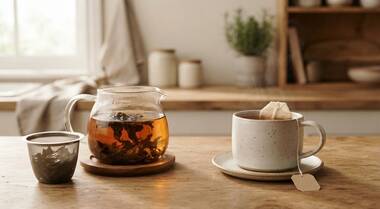
Loose leaf tea usually tastes better than the tea in a standard teabag, because it is typically a higher grade of leaf with more room to open. But quality depends on the specific tea, not the format: a good whole-leaf tea in a roomy pouch can beat a mediocre loose blend, and a well-made teabag is a perfectly good cup.
At seven in the morning, convenience has a persuasive voice. It says: kettle, mug, teabag, done. By Sunday afternoon, however, the broad leaves in a glass pot begin making their case. They twist, expand, and turn the water amber as deliberately as scenery changing between acts. The difference between loose tea and teabags is partly practical, but it is also about flavor, control, and how much attention you want to give a cup.
What is the difference between loose tea and teabags?
Loose tea consists of leaves, buds, herbs, spices, flowers, or fruit pieces measured directly into an infuser or teapot. Teabags contain similar ingredients inside a porous pouch, usually portioned for one cup. Neither format automatically guarantees quality. A teabag may hold excellent tea, while loose tea can be stale or poorly made. The meaningful distinctions are the size and condition of the ingredients, the room they have to steep, and the control the brewer has over quantity and time.
Many conventional teabags use small leaf particles because they infuse quickly and produce a strong, consistent cup. Their greater exposed surface area allows water to extract flavor rapidly. That speed is useful, particularly for a brisk breakfast tea, but it can also make oversteeping more noticeable. Loose tea often contains larger or whole leaves, which tend to release their character more gradually.
Leaf grade is the heart of the quality question. Tea is sorted by how intact the leaf is. Whole leaf and large broken grades keep their structure and release flavor over time. Fannings and dust, the smallest grades and common in conventional bags, release it all at once, which is why bagged tea can taste strong and a little harsh. When we say loose tea is often "higher quality," this is mostly what we mean.
Loose tea vs. teabags at a glance
| Factor | Loose tea | Typical teabag |
|---|---|---|
| Leaf grade | Whole or large pieces of leaf | Often small particles, fannings or dust |
| Room to expand | Leaves open fully in the pot or infuser | Limited by the size of the pouch |
| Flavor release | Gradual, layered | Fast, strong, easier to oversteep |
| Re-steeping | Many teas give several good infusions | Usually one |
| Control | Adjust amount and time cup by cup | Portioned for you |
| Convenience | Needs measuring and cleanup | Tidy, portable, no measuring |
| Variety | Wide range of origins and styles | Often blends built for consistency |
Why loose leaf tea can taste different
Tea leaves need contact with water. When larger leaves have space to open, water can circulate around them and draw out layers of aroma, flavor, texture, and astringency. A rolled oolong such as Jade Oolong makes the process unusually visible. Its compact leaves slowly unfurl, revealing a fresh floral aroma and delicate texture over several infusions.
Whole-leaf black tea can be equally instructive. Golden Monkey, made with carefully plucked leaves and buds, offers notes of roasted apple, cocoa, and spice. A crowded bag would not erase those flavors, but an ample infuser gives the leaves room to move and makes it easier to adjust the strength to your preference.
Loose tea also invites closer inspection. You can see the leaf shape, smell the dry ingredients, and measure a little more or less depending on the mug. This is not merely aesthetic fussing, although tea drinkers have elevated aesthetic fussing into a venerable art. It is useful information about what you are brewing.
When teabags make perfect sense
Teabags are tidy, portable, and wonderfully difficult to spill across a keyboard. They require no measuring and make cleanup nearly instantaneous. At work, while traveling, or during a morning governed by the clock, that simplicity can matter more than observing each leaf's dramatic transformation.
The format is also familiar. For generations, the teabag has helped make tea an easy household habit rather than a ceremony requiring specialized knowledge. A dependable blend such as Earl Grey, with its recognizable pairing of black tea and bergamot, suits this direct approach. The same profile can also be explored as loose tea with Earl Grey Bravo, allowing the strength and overall intensity to be adjusted cup by cup.
How to judge a good teabag. Open one and look. Recognizable pieces of leaf are a good sign; a fine, dusty powder usually means a quick, flat and slightly bitter cup.
Loose tea without the inconvenience
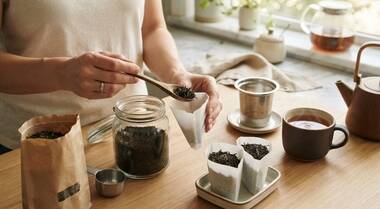
The strongest argument against loose tea is usually cleanup, followed closely by uncertainty. Both are easier to address than they may appear. Use roughly one teaspoon of tea per cup as a starting point, then follow the recommended water temperature and steeping time for that tea. Adjust the amount or timing on the next infusion. Tea is forgiving, and your palate is a more useful guide than an inflexible formula.
A roomy basket infuser or teapot handles everyday brewing neatly. For the portability of a teabag with the flexibility of loose leaves, paper tea filters can be filled at home and carried to the office or on a trip. This hybrid method offers portioned convenience without surrendering control over what goes inside.
Loose tea vs. teabags: which should you choose?
Choose teabags when speed, consistency, and minimal cleanup are paramount. Choose loose tea when you want to explore leaf quality, fine-tune strength, or enjoy multiple steepings from teas suited to them. Storage matters in either case. Keep tea sealed away from heat, moisture, light, and strong odors.
There is no need to pledge allegiance to one camp. A sensible tea cupboard can accommodate hurried mornings and leisurely afternoons. The real difference between loose tea and teabags is not virtue but possibility: one format arrives ready to work, while the other gives you more room to play.
Frequently asked questions
Is loose leaf tea better quality than tea bags?
Often, because it is usually a higher leaf grade with room to open. But quality depends on the specific tea, and a good teabag can beat a stale or poorly made loose tea.
Is loose leaf tea worth it?
If flavor and control matter to you, usually yes. Many teas also give several good infusions, which can bring the cost per cup down.
Do tea bags contain plastic?
Some do, depending on the bag material and how it is sealed. Others use paper, cornstarch-based fibers or cotton. Check the maker's description of the bag.
Does loose leaf have more caffeine?
Not reliably. Caffeine depends mostly on the tea type, amount, water temperature and steep time rather than the format.
Can you re-steep tea bags?
You can, but most are largely spent after one infusion. Whole-leaf teas such as oolongs often give several.
Do I need special equipment to brew loose tea?
No. A basket infuser, a teapot with a strainer, or paper tea filters all work.