How Much Loose Leaf Tea Should You Use?
by Adagio Teas
October 09, 2026
A Simple Starting Point
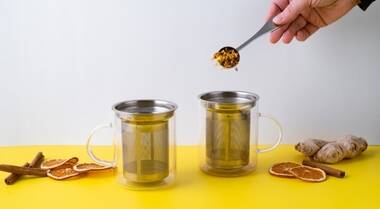
For most loose leaf teas, begin with 2 to 3 grams of tea per 8 fluid ounces, or about 240 milliliters, of water. If you do not own a small kitchen scale, start with roughly one level teaspoon. That familiar spoonful is a convenient shorthand, not a universal law. Tea leaves vary dramatically in size and density, so a teaspoon of compact green tea may weigh considerably more than a teaspoon of airy white tea. When available, follow the specific directions for your tea.
Mug size matters, too. The ceramic vessel called a cup in your cupboard may hold 12, 14, or 16 ounces. For a 12-ounce mug, use about 3 to 4.5 grams. For a 16-ounce mug, use 4 to 6 grams. A teapot should be measured by the water it actually holds, not by the number of optimistic servings in its description. Fill it with water, pour that water into a measuring cup, and the mystery is settled.
Why One Teaspoon Does Not Fit Every Tea
Leaf shape explains why volume measurements can mislead. Fine, compact leaves settle closely together. Long, twisted leaves leave pockets of air. Broad white tea buds can make a spoon look lavishly full while weighing very little. The downy buds of silver needle, for example, occupy more space than tightly formed leaves. Measuring this tea by volume may require a generous-looking spoonful. A digital scale avoids the visual drama and gives every tea the same mathematical footing.
Rolled teas present their own charming complication. The leaves may begin as small pellets and expand substantially in water. jade oolong slowly unfurls over several infusions, so the initial portion needs room to open. Meanwhile, black dragon pearls offer an unusually convenient unit. Begin with 2 to 3 pearls per cup, then adjust to taste. Here, counting is more useful than trying to balance a pearl on a teaspoon.

Strength Is More Than Leaf Quantity
If a brew tastes weak, adding more leaf next time is often better than steeping the same portion far beyond its recommended time. A longer infusion extracts more flavor, but it can also bring out excessive bitterness and astringency, especially in black and green teas. More leaf with an appropriate steep time can create greater body and aroma without making the cup harsh. Conversely, if a tea is overwhelming, reduce the amount of leaf slightly before changing every other variable at once.
Water temperature also changes what the leaves reveal. Delicate green teas generally favor cooler water than robust black teas or herbal infusions. A measured portion of sencha premier may taste crisp, sweet, and clean when brewed with suitably cooler water, yet become more assertive if treated like a breakfast black tea. Quantity, temperature, and time work as a trio. Change one variable at a time, and you will know which adjustment improved the cup.
Special Cases: Matcha, Chai, and Iced Tea
Matcha does not follow ordinary loose leaf rules because the powdered leaf is whisked into water and consumed rather than strained away. Follow the directions for your preparation style, using a scale when you want repeatable results. Chai brewed with milk may need a stronger tea-to-liquid ratio because milk and sweetener can soften the tea's perceived intensity. Iced tea brewed hot also benefits from extra leaf when it will be poured over ice, since melting ice dilutes the finished drink.
For multiple short infusions, as in gongfu-style brewing, the logic changes again. This method pairs substantially more leaf with much less water and very brief steeps. It is not merely an excessively strong version of Western-style brewing. It is a different approach that reveals how a tea's flavor develops from one infusion to the next.
Build Your Own Reliable Formula
Begin with 2 to 3 grams per 8 ounces of water, follow the tea's specific brewing directions, and taste before revising. Keep a brief note of leaf weight, water volume, temperature, and time when a cup is especially good. The perfect amount is not a single sacred number. It is a repeatable ratio shaped by the leaf, the vessel, and your palate. Once you know your preferred ratio, loose leaf tea stops being guesswork and becomes what it should be: a small, dependable daily pleasure.